

Capterra offers objective, independent research and verified user reviews. We may earn a referral fee when you visit a vendor through our links.
Learn more
Our commitment
Independent research methodology
Capterra’s researchers use a mix of verified reviews, independent research and objective methodologies to bring you selection and ranking information you can trust. While we may earn a referral fee when you visit a provider through our links or speak to an advisor, this has no influence on our research or methodology. Learn more
How Capterra verifies reviews
Capterra carefully verified over 2.5 million+ reviews to bring you authentic software and services experiences from real users. Our human moderators verify that reviewers are real people and that reviews are authentic. They use leading tech to analyze text quality and to detect plagiarism and generative AI. Learn more
How Capterra ensures transparency
Capterra lists all providers across its website—not just those that pay us—so that users can make informed purchase decisions. Capterra is free for users. Software and service providers pay us for sponsored profiles to receive web traffic and sales opportunities. Sponsored profiles include a link-out icon that takes users to the provider’s website. Learn more
HR Software
HR Software is a comprehensive solution designed to streamline and automate various human resource management tasks. With HRMS management software, businesses can efficiently manage employee information, track attendance, process payroll, and administer benefits. HR systems provide a centralized platform for managing employee data, ensuring accuracy and compliance with regulations. HR software encompasses various functionalities, including recruitment and applicant tracking, performance management, training and development, and employee engagement. Whether you are a small business or a medium-sized enterprise, our directory of HR software for SMEs offers a variety of options to meet your specific needs. From managing employee records to optimising workforce management, our human resource management software solutions provide the tools necessary to enhance productivity, streamline processes, and foster a positive work environment. Browse our directory to find the best HR software for your organization's needs in Australia. Read more Read less
The best HR Software solutions for Australian businesses in 2025
Human Resources (HR) software is essential for efficiently managing HR functions, streamlining processes, and enhancing organisational performance. In Australia, businesses prioritise features such as employee database management, HR management, and employee scheduling as crucial components when selecting HR software. 85% of Australian professionals who utilise HR systems say that it is easy to use [a]. Furthermore, one in five (20%) Australian companies identified investing in HR management systems as a top priority for 2025. [b]
With numerous software options available, selecting the right HR system can be challenging. To aid your decision-making, we've compiled a comprehensive overview of Australia's most popular human resources software based on an analysis of 11,534 verified user reviews. This guide highlights the features deemed most vital by users, alongside pricing insights and detailed Pros and Cons based on user feedback. If the featured options don't meet your needs, our catalogue offers a broad selection of HR products to explore.
Top solutions

Deel

BrightHR

Rippling
ADP Workforce Now
Workable

Factorial
Sage HR

Dayforce HCM

Workday HCM
How we picked the software on this list
Our independent and objective research is based on market demand signals in Australia along with an analysis of our proprietary data. This includes product information and verified user reviews in the last two years as of June 2025. Sponsorship or client status has no influence on the selection of products in the lists, but it may impact the order in which products appear. Read our full methodology.
Highly Rated for Sick Leave Tracking
Top rated feature:
Onboarding
Starting Price:
USD 10.00/month
Free trial
BambooHR is a comprehensive HR management software with a 4.59 out of 5 rating from over 2,941 verified user reviews. It centralises employee data, automates HR tasks, and enhances the employee experience with self-service options. Key features include onboarding, performance tracking, time-off management, and document management. Users appreciate its user-friendly interface and robust reporting tools. BambooHR is particularly beneficial for small to medium-sized businesses, offering tools for recruitment, payroll integration, and employee self-service.
Features
-
Employee Database: Reviewers appreciate the centralised, customisable, and user-friendly database for managing employee information, with features like compliance tracking, performance tracking, and advanced search.
-
Online Time Tracking: Users find it easy to track time, though some mention limitations like lack of detailed breakdowns and issues with lunch breaks. Integration with payroll is valued.
-
HR Management: Reviewers highlight the comprehensive and user-friendly platform for managing HR tasks, including employee self-service, benefits management, and performance tracking.
-
Vacation/Leave Tracking: Users value the real-time tracking and approval process for PTO, though some mention issues with integration and flexibility in leave categories.
-
Time Off Management: Reviewers appreciate the ease of requesting and approving time off, with features like future PTO calculation and integration with Google Workspace.
-
Online Time Clock: Users find the time clock easy to use and accurate, though some desire features like automatic lunch deductions and geo-fencing. Integration with payroll is noted.
Pros & cons
Pros:
Reviewers appreciate BambooHR for its robust employee management capabilities, including easy access to employee profiles, time off requests, and organisational charts. Users find the platform intuitive and user-friendly, making managing employee information, attendance, and performance simple. The HR management features streamline processes like document management and time tracking, enhancing overall efficiency. Employee tracking is another strong point, with tools for monitoring performance, time-off, and onboarding. Customer support is frequently praised for being responsive and helpful, ensuring a smooth user experience.
Cons:
However, some users find the payroll management feature lacking, as it relies on third-party integrations and can be cumbersome. Pricing is also a concern, with some finding it expensive, especially for smaller businesses. Reporting capabilities are limited, with users desiring more customisation and flexibility.
Value for Money
359 reviews discussing Value for Money, 60% positive.
Reviewers have mixed opinions on BambooHR's value for money. Many users appreciate the software's affordability, especially for small to medium-sized businesses, and find it offers a comprehensive range of features at a reasonable price. They value the free trial period, the ability to grow without escalating costs, and the inclusion of essential HR functionalities without hidden fees. Users also highlight the cost savings in time and resources due to efficient processes and automation.
However, some reviewers find BambooHR expensive, particularly for small businesses or those with limited budgets. They mention that the pricing structure can be unclear and that additional features often cost more. Some users feel the software lacks certain functionalities, and the cost increases over time without corresponding enhancements. The expense of integrating additional modules and the lack of transparency in pricing are also points of concern.
Popular Integrations
-
Indeed: Users integrate BambooHR with Indeed to streamline job postings, track candidates, and manage recruitment more efficiently. --- based on 49 reviews, 33 snippets.
-
Slack: Users integrate BambooHR with Slack to receive notifications, manage PTO requests, and streamline HR-related communications within a centralised platform. --- based on 40 reviews, 24 snippets.
-
Google Calendar: Users integrate BambooHR with Google Calendar to automatically sync employee time off, creating a seamless way to track leaves and manage schedules. --- based on 30 reviews, 14 snippets.
-
Okta: Users integrate BambooHR with Okta for single sign-on and multifactor authentication, enhancing security and simplifying login processes. --- based on 15 reviews, 6 snippets.
Highest Rated
Top rated feature:
Performance Management
Starting Price:
USD 5.00/month
Free trial
Deel is a comprehensive HR platform with a 4.82 out of 5 rating from over 2,019 verified user reviews. It simplifies global hiring, onboarding, and payroll management by automating compliance, contracts, and payments. The platform supports multiple currencies and payment methods, ensuring flexibility and efficiency. Its user-friendly interface and robust features make it suitable for managing remote teams and navigating international employment regulations, providing a seamless experience for employers and employees.
Features
-
Payroll Management: Users appreciate global payroll support, compliance, and automation, though some find the interface and setup confusing.
-
Electronic Signature: Reviewers value the convenience, speed, and security of signing contracts digitally, enhancing remote work efficiency.
-
Multi-Country: Deel users highlight the ease of receiving payments globally, supporting remote work and different currencies.
-
Direct Deposit: Users find direct deposit convenient and fast, though some face initial setup challenges with bank linking.
-
Document Management: Reviewers appreciate having all documents in one place, with easy access and strong security features.
-
Payroll Reporting: Users value detailed, clear payroll reports for tracking earnings and deductions, aiding financial management.
Pros & cons
Pros:
Users appreciate Deel for its robust payment management capabilities, offering multiple payment methods, including bank transfers, PayPal, and cryptocurrency. The platform supports various currencies and ensures compliance with local regulations, making it ideal for businesses with remote teams. The user interface is intuitive and user-friendly, simplifying contract creation and financial management. Users also value the flexibility in withdrawal methods, including bank transfers, Deel Instant Card, and PayPal, which cater to diverse needs. The platform's seamless integration with other financial services and efficient customer support enhance the user experience.
Cons:
However, users express concerns about transaction fees, which can be high, especially for smaller businesses or specific countries. The availability of Deel cards is limited in some regions, and users find the additional fees for non-USD purchases inconvenient. Email notifications can be excessive and sometimes irrelevant, and the exchange rates are not always competitive. Additionally, tax management can be complex and burdensome for some users.
Value for Money
717 reviews discussing Value for Money, 79% positive.
Most users consider Deel a valuable investment due to its comprehensive international hiring and payroll management features. They appreciate the platform's flexibility in payment methods, support for multiple currencies, and the ability to transfer funds quickly and securely. Users highlight the ease of use, transaction transparency, and convenience of local currency payments without additional transfer fees.
However, some reviewers mention that Deel's pricing can be high, especially for small businesses or startups. They also note occasional delays in payment processing and high fees associated with certain transactions and currency conversions.
Popular Integrations
-
PayPal: Users integrate Deel with PayPal for flexible and fast payment options, which many employees prefer for withdrawals, ensuring timely and automated payments. --- based on 29 reviews, 25 snippets.
-
Payoneer: Users integrate Deel with Payoneer to transfer funds to local bank accounts and utilise Payoneer's physical debit card for purchases despite higher transfer fees. --- based on 22 reviews, 18 snippets.
-
Xero: Users integrate Deel with Xero to simplify accounting, enhance efficiency, and reduce accounting errors through automated data synchronisation and easier payment reconciliation. --- based on 10 reviews, 3 snippets.
-
Coinbase: Users integrate Deel with Coinbase for cryptocurrency withdrawals, although some face high transfer fees and regional restrictions, with improvements expected. --- based on 9 reviews, 6 snippets.
Highly Rated for Ease of Use
Top rated feature:
Performance Management
Starting Price:
$6.00/month
Free trial
BrightHR holds a 4.63 out of 5 rating from over 107 verified user reviews, offering a platform for HR management, time tracking, leave management, payroll, and health and safety functions. Users highlight its ease of use, helpful support, and features such as reminders, employee tracking, and document storage. The system is noted for consolidating HR information, facilitating holiday requests, and providing accessible planners, with additional tools for rota scheduling and payroll integration.
Features
-
Employee Database: Users value the central hub for storing employee records and documents, though some find the initial setup process a bit overwhelming.
-
HR Management: Reviewers highlight comprehensive HR tools and policy management, but note that more industry-specific features would benefit some sectors.
-
Vacation/Leave Tracking: The leave management system is praised for its simplicity and effectiveness, although a few users mention limitations in customizing holiday types.
-
Payroll Management: Many appreciate the straightforward payroll processing and government reporting integration, but some find syncing with the rota system could be improved.
-
Scheduling: Staff scheduling and clock-in features are useful for tracking hours, yet several users feel the rota module lacks flexibility for complex shifts.
-
Customer Support: Customer service is frequently commended for responsiveness and helpful onboarding, though there are occasional concerns about contract terms and communication.
Pros & cons
Pros:
Reviewers consistently highlight BrightHR’s ease of use, noting its intuitive interface, straightforward navigation, and quick setup, which help them centralize HR tasks and save time. Users appreciate the responsive and knowledgeable customer support, mentioning prompt assistance and helpful onboarding. Employee management features, especially payroll integration and centralized employee information, are valued for improving efficiency and reducing administrative burden. Leave tracking is praised for its convenience and effective reminders, while document management helps users stay organized and transition away from spreadsheets.
Cons:
However, users find the rota management system basic and difficult to use, and some feel reporting options are limited and less concise.
Highly Rated for Time Off Management
Top rated feature:
Payroll Management
Starting Price:
$12.00/month
Free trial
Rippling holds a 4.87 out of 5 rating from over 3,924 verified user reviews, offering an integrated platform that centralizes HR, payroll, benefits, IT, and finance functions. Users highlight its ability to streamline onboarding, payroll processing, time off management, expense tracking, compliance, and device management within a single dashboard. The platform is noted for its automation, customizable workflows, and clear interface, supporting both local and international teams while consolidating administrative tasks for increased efficiency.
Features
-
Direct Deposit: Rippling users consistently highlight the ease and flexibility of setting up direct deposit, including splitting pay across multiple accounts, timely and reliable payments, and instant notifications, though some mention the interface for entering amounts can be confusing.
-
Payroll Management: Reviewers of Rippling value its intuitive payroll management, real-time tracking, and integration with time tracking and benefits, but some note initial setup complexity, confusing pop-ups, and rare issues with expedited payroll or tax calculations.
-
Payroll Reporting: Users appreciate Rippling’s detailed, intuitive payroll reports, easy access to pay breakdowns and deductions, CSV export, and integration with platforms like QBO, though some wish for more customizable reporting options.
-
Benefits Management: Rippling users find benefits management streamlined, with easy enrollment, plan comparisons, and centralized access, but some report setup confusion, calculation errors, and limited customer support for complex benefit schemes.
-
Tax Return Form Preparation: Reviewers highlight how Rippling makes tax return forms preparation and access simple and timely, with digital delivery, reminders, and centralized document storage, though a few mention rare filing errors or issues after leaving the company.
-
Tax Compliance: Users value Rippling’s automated tax calculations, multi-state compliance, and timely alerts, but some cite challenges with customer support, nuanced local setups, and occasional errors in tax filings or withholdings.
Pros & cons
Pros:
Reviewers consistently highlight Rippling’s ease of use, intuitive navigation, and user-friendly interface, which make daily HR tasks like managing payroll, benefits, and time off straightforward and efficient. Users appreciate having all essential employee management tools—such as pay stubs, benefits, onboarding, and organizational charts—centralized in one platform, saving time and reducing administrative hassle. The ability to access pay and benefits information quickly, manage PTO, and handle direct deposits is frequently mentioned as a major benefit.
Cons:
On the downside, users find the login process cumbersome due to frequent re-authentication, and many consider reporting and electronic signature features less robust or difficult to use.
Value for Money
262 reviews discussing Value for Money, 72% positive.
Most reviewers indicate that Rippling offers strong value for money due to its ability to centralize HR, payroll, benefits, and expense management in one platform, reducing administrative overhead and saving both time and costs. They appreciate the customizable, a la carte pricing, which allows them to pay only for needed features, and note that Rippling is often more affordable than previous solutions, especially for international hiring and small teams. However, users frequently mention that pricing lacks transparency, add-on fees accumulate quickly, and billing can be confusing, making it potentially expensive for smaller businesses or those requiring many modules.
Popular Integrations
-
Slack: Users integrate Rippling with Slack to automate onboarding, manage user accounts, and streamline access to communication channels, especially for remote teams and daily collaboration. --- based on 43 reviews, 26 snippets.
-
Google Workspace: Integration automates employee onboarding and offboarding, provisioning emails and syncing calendars, ensuring seamless collaboration and account management across the organization. --- based on 30 reviews, 16 snippets.
-
Gmail: Users connect Rippling with Gmail to automate new employee account setup, streamline onboarding, and centralize access to email and related tools for efficiency. --- based on 18 reviews, 7 snippets.
-
Lattice: Integration allows automatic import of employee data from Rippling into Lattice, simplifying HR management and connecting feedback and performance tools within the organization. --- based on 16 reviews, 9 snippets.
Highly Rated for Compensation Management
Top rated feature:
Payroll Management
Starting Price:
No pricing found
Free trial
ADP Workforce Now is a comprehensive HR and payroll management solution with a 4.42 out of 5 rating from over 6,830 verified user reviews. It integrates payroll processing, benefits administration, and time tracking into a single platform, offering employee self-service portals, customisable dashboards, and robust reporting capabilities. The software is designed for ease of use and scalability, making it suitable for growing companies. It also ensures regulatory compliance and provides strong data security.
Features
-
Direct Deposit: Reviewers appreciate the ease of setting up and managing direct deposits, including the ability to split deposits across multiple accounts. Users value the convenience and time savings, though some note the need for account verification.
-
Payroll Management: Users highlight the ease of accessing pay stubs, managing payroll, and correcting errors. Some find the interface outdated, but overall, it is praised for its efficiency and comprehensive features.
-
Payroll Reporting: Reviewers value the ease of generating and customising payroll reports. While some find it time-consuming to select the right report, the feature is generally appreciated for its accuracy and comprehensiveness.
-
Self-Service Portal: Users appreciate the ability to access and update personal information, payroll, and benefits without HR assistance. While navigation can be challenging, the portal is valued for its convenience and time-saving capabilities.
-
Tax Return Preparation: Reviewers find tax return preparation easy and convenient, with the ability to access and print forms online. Some mention occasional software issues, but the feature is a significant time-saver.
-
Tax Compliance: Users highlight the importance of tax compliance features for ensuring accurate and timely tax filings. The feature is praised for its ease of use and ability to keep up with tax regulations, though some limitations with handling income tax returns.
Pros & cons
Pros:
Users appreciate ADP Workforce Now for its comprehensive payroll management capabilities, which streamline payroll processing, benefits administration, and time tracking. The platform's user-friendly interface and centralised system simplify payroll tasks, making it easier to manage employee data and comply with regulations. Additionally, ADP's employee management features are highly valued, allowing for efficient personnel management, remote workforce tracking, and easy access to employee information. The self-service portal for pay stubs and tax management is also praised for its convenience, enabling employees to easily access their pay information, tax forms, and benefits.
Cons:
However, users report challenges with the reporting features, which can be complex and lack customisation options. Updates and upgrades sometimes cause confusion and disrupt workflows, and support requests often result in long wait times and inconsistent assistance. Website performance issues, such as slow loading times and browser compatibility problems, hinder user experience. Lastly, customer service is frequently criticised for being unresponsive and unhelpful, leading to frustration among users.
Value for Money
638 reviews discussing Value for Money, 63% positive.
Reviewers have mixed opinions about the value for money for ADP Workforce Now. Many users appreciate the software's comprehensive features, such as payroll automation, tax preparation, and time tracking, which they find streamline their processes and save time and money. They also value the easy access to payment information, the integration with other systems, and the additional benefits like discounts and free training webinars. Some users mention that despite the higher cost, the efficiency and reliability of the system justify the expense.
However, other reviewers find the software expensive, especially for small businesses, and criticise the need to purchase multiple modules to access all features. They also mention that the pricing structure is not transparent and that customer support can be slow and unhelpful. Some users report issues with system updates and the complexity of setup, which can add to the overall cost and time investment.
Popular Integrations
-
Microsoft Outlook: Users integrate ADP Workforce Now with Microsoft Outlook to sync time off requests, send automated email notifications, and track time off conveniently. --- based on 13 reviews, 7 snippets.
-
MakeShift: Users integrate ADP Workforce Now with MakeShift to link scheduling with payroll, making payroll processing easier and more efficient. --- based on 2 reviews, 2 snippets.
-
SAP Concur: Users integrate ADP Workforce Now with SAP Concur for expense tracking and management, streamlining financial operations. --- based on 2 reviews, 1 snippet.
-
Absorb LMS: Users integrate ADP Workforce Now with Absorb LMS to ensure employee compliance with LMS modules, facilitating training and development. --- based on 1 review, 1 snippet.
Highly Rated for Applicant Tracking
Top rated feature:
Recruitment Management
Starting Price:
USD 299.00/month
Free trial
Workable holds a 4.38 out of 5 rating from over 486 verified user reviews, serving as an HR-centric recruitment platform that streamlines job postings, applicant tracking, and onboarding workflows. Users highlight its intuitive interface, AI-powered candidate sourcing, collaborative hiring tools, and integration options with job boards and HR systems. The platform offers features such as video interviews, referral programs, and customizable templates, supporting both small and growing organizations in managing the hiring process efficiently.
Features
-
Candidate Tracking: Workable users value customizable candidate stages, easy tracking of candidate progress, and efficient organization, with quick access to candidate status and the ability to keep records for future roles.
-
Job Posting: Reviewers highlight seamless multi-channel job posting, strong integrations with LinkedIn, Indeed, and Glassdoor, user-friendly templates, and time-saving one-click distribution to various boards.
-
Applicant Tracking: Users appreciate automated workflows, centralized applicant communication, easy resume downloads, and intuitive tracking, though some mention occasional frustrations with moving candidates between jobs.
-
Candidate Management: Reviewers of Workable note structured workflows, collaborative tools like internal notes and ratings, smooth integration with Microsoft and Google, and effective communication with candidates.
-
Application Management: Workable users find application sorting and status updates easy, value multi-channel application intake, but some mention AI scoring inconsistencies when matching profiles to job descriptions.
-
Resume Search: Users appreciate efficient resume extraction, Boolean search improvements, and filtering by job/location, though some find the search too general and suggest more precise filtering options.
Pros & cons
Pros:
Reviewers find Workable highly effective for managing candidate interviews, praising its intuitive interface, streamlined scheduling, and centralized candidate tracking, which save time and improve organization. Users appreciate the robust recruitment process, collaborative tools, and automation features that simplify hiring and enhance team communication. The user interface receives consistent positive feedback for being clean, user-friendly, and easy to navigate, requiring minimal training. Customer support is frequently described as responsive and helpful.
Cons:
However, users mention frustrations with email integration, noting occasional syncing issues and confusing in-app emailing. Reporting capabilities are seen as basic and lacking customization, and many consider the pricing structure confusing and expensive.
Value for Money
129 reviews discussing Value for Money, 69% positive.
Reviewers say Workable offers a range of features at a price point they often find affordable, especially for small businesses and startups. They appreciate the free trial, flexible subscription options, and the inclusion of free job board postings, which help reduce recruitment costs. Users highlight that the software saves time and streamlines hiring, making the investment worthwhile. However, they also mention that pricing can be confusing, with some plans and add-ons becoming expensive, particularly for larger businesses or those with minimal hiring needs. Some users feel recent price increases and unclear billing detract from its overall value.
Popular Integrations
-
Gmail: Users integrate Workable with Gmail to centralize candidate communications, sync email conversations, tag colleagues, and keep application-related emails organized within the hiring workflow. --- based on 16 reviews, 10 snippets.
-
Microsoft Outlook: Workable integrates with Outlook to enable direct interview scheduling, calendar syncing, and streamlined workflow, though some users report challenges with full integration and email retrieval. --- based on 11 reviews, 8 snippets.
Highly Rated for Employee Database
Top rated feature:
Employee Management
Starting Price:
USD 8.00/month
Free trial
Factorial holds a 4.4 out of 5 rating from over 294 verified user reviews and is recognized for consolidating HR functions such as recruitment, onboarding, time tracking, time-off management, and performance reviews into a single, intuitive platform. Users highlight its clean interface, ease of use, and ability to centralize employee data, schedules, and documentation. The software is noted for streamlining HR processes, offering automation, and supporting both small and mid-sized organizations with a range of configurable features.
Features
-
Timesheet Management: Factorial users value easy digital time tracking, real-time schedule visibility, and centralized control, though some request more advanced options.
-
Payroll Management: Reviewers highlight streamlined payroll processing, bulk payslip distribution, and integrated reporting, but note limited support outside main EU markets.
Pros & cons
Pros:
Reviewers consistently highlight Factorial’s ease of use, noting its intuitive interface and minimal learning curve, which benefits both tech-savvy and non-technical staff. Users appreciate how absence and personnel management features streamline HR processes, allowing for quick leave requests, centralized employee data, and improved team oversight. The platform’s tools for employee management and control help unify workflows and save time, especially for small to mid-sized companies.
Cons:
However, many users express concerns about high and increasing pricing, limited and slow customer support, and reporting features that lack customization and historical data. Issues with pay slips and document signing functionality are also frequently mentioned.
Value for Money
50 reviews discussing Value for Money, 61% positive.
Reviewers say Factorial offers a wide range of HR features—such as time tracking, payroll, schedule control, and free time management—that help them save time and streamline processes, making the investment worthwhile for many. They appreciate the availability of free trials and a free version, which allow them to test the platform’s functionalities before committing. Some find the price affordable and the cost per user justified by the features included. However, others consider Factorial expensive compared to competitors, especially for small businesses or when only a subset of features is needed, and mention concerns about hidden costs and frequent price increases.
Popular Integrations
- Microsoft Excel: Users integrate Factorial with Excel mainly to export data for custom reporting, KPI tracking, and to replace manual HR tasks previously managed in spreadsheets. --- based on 12 reviews, 11 snippets.
Highly Rated & Free Trial
Top rated feature:
Payroll Management
Starting Price:
USD 5.50/month
Free trial
Sage HR is a comprehensive HR management software with a 4.46 out of 5 rating from over 353 verified user reviews. It supports various HR functions, including recruitment, performance management, payroll, and leave management. The platform offers customisable features, a robust employee database, and automation capabilities to streamline HR processes. Users appreciate its modular design, integration with other tools, and the ability to manage employee information efficiently. However, some users find the mobile app less intuitive and the interface somewhat outdated.
Features
-
Employee Database: Users appreciate the central repository for documents, though some find signing functions difficult.
-
Access Controls/Permissions: Reviewers value the ease of setting permissions, though some find setup confusing.
-
HR Management: Users find it critical to manage HR data, though some limitations are noted compared to other products.
-
Vacation/Leave Tracking: Reviewers highlight easy tracking and accessibility, though some do not fully utilise it.
-
Payroll Management: Users find it accurate and easy to use, with secure data protection.
-
Time Off Management: Reviewers appreciate the up-to-date tracking, though complex policies require manual entries.
Pros & cons
Pros:
Users appreciate Sage HR for its comprehensive Employee Management capabilities, which streamline HR processes from recruitment to payroll, all within a single platform. The software's integrated modules for time management, personnel management, and performance appraisals enhance administrative efficiency and employee engagement. The Customer Service is highly praised for its responsiveness and helpfulness, making it easy to resolve issues and implement user feedback. The User Interface is noted for being intuitive and user-friendly, facilitating easy navigation and quick adoption. Leave Management is another strong point, with features that simplify leave requests and approvals, reducing paperwork and improving coordination. Staff Management is efficient, offering scalable scheduling, time tracking, and performance management solutions.
Cons:
However, users face challenges with Request Approval, citing issues with notification settings and the inability to manage approvals efficiently. Vacation Tracking can be confusing and lacks features for larger enterprises. The Information Structure is seen as inflexible and basic, making document management cumbersome. Users also report difficulties with Employee PTO Data, including data import and update issues. The Organizational Chart lacks customisation and user-friendliness, limiting its utility for some users.
Value for Money
50 reviews discussing Value for Money, 72% positive.
Most users consider Sage HR a cost-effective solution, offering a range of customisable features at a budget-friendly price. They appreciate the choice of pricing plans that cater to different business needs and the availability of free trials. Users find it particularly valuable for managing HR functions in a time-saving and efficient manner.
However, some reviewers mention that the cost can become prohibitive with more users, and module-based billing can be restrictive. A few users also feel that recent price increases do not offer additional value.
Popular Integrations
-
Google Calendar: Users integrate Sage HR with Google Calendar to centralise information, simplify scheduling, and ensure public access to shared events. --- based on 9 reviews, 7 snippets.
-
Microsoft Outlook: Users integrate Sage HR with Microsoft Outlook to streamline vacation requests, improve scheduling, and utilise Outlook's intuitive interface for business control. --- based on 9 reviews, 7 snippets.
-
Gmail: Users integrate Sage HR with Gmail to manage HR tasks efficiently within their email platform, which is particularly beneficial for small companies. --- based on 2 reviews, 1 snippet.
Highly Rated for Payroll Management
Top rated feature:
Time & Attendance
Starting Price:
No pricing found
Free trial
Dayforce HCM holds a 4.3 out of 5 rating from over 1,049 verified user reviews, offering a unified platform for payroll, HR, benefits, time and attendance, and talent management. Users highlight its ability to centralize employee data, streamline onboarding, and provide real-time analytics and reporting. The system supports multiple business entities, customizable configurations, and mobile access, with features such as digital timesheets, document management, and integrated workforce management tools.
Features
-
Direct Deposit: Dayforce HCM users consistently highlight the reliability, timeliness, and ease of use of direct deposit, valuing employee self-service for setup and updates, though some mention challenges with multiple accounts and audit documentation.
-
Payroll Reporting: Reviewers appreciate Dayforce HCM’s robust, easy-to-run payroll reports and built-in analytics, but note that custom reporting and combining data across pay groups can be complex and less intuitive.
-
Payroll Management: Users of Dayforce HCM value its real-time payroll calculations, automation, and ease of managing multiple pay cycles, though some mention a learning curve and the need for more specialized salary management features.
-
Tax Compliance: Reviewers rely on Dayforce HCM’s automated tax compliance and Ceridian tax support for multi-state operations, but some find the process less automated than expected and request improvements in legal updates and user interface.
-
Employee Database: Dayforce HCM users find the employee database comprehensive, easy to update, and essential for payroll and reporting, though some mention data transfer issues and desire better organization and auditing tools.
-
Tax Return Form Preparation: Reviewers highlight Dayforce HCM’s automated, accurate, and timely tax return form preparation, with easy employee access and compliance, though some stress the importance of year-end audits and training for accuracy.
Pros & cons
Pros:
Reviewers appreciate Dayforce for its unified approach to payroll, employee management, and scheduling, noting that having HR, payroll, benefits, and time tracking in one system streamlines processes and reduces errors. Users find payroll processing efficient, with real-time calculations and robust audit features, and value the ease of accessing paystubs and managing pay information. Employee management benefits from centralized records, self-service options, and intuitive navigation, while scheduling tools help organize shifts and time off efficiently.
Cons:
However, users frequently mention slow, inconsistent customer support, complex and cumbersome reporting, challenges with the implementation team, approval workflows that lack notifications, and disruptive software updates.
Value for Money
86 reviews discussing Value for Money, 39% positive.
Reviewers say Dayforce HCM offers a wide range of HR, payroll, and benefits management features that help them save time and reduce paperwork, with some finding it more affordable than similar platforms and appreciating the cost savings from automation and centralized processes. They mention that the platform’s modular structure allows for tailored functionality, but note that each module comes with additional costs, which can add up quickly. Many users feel the overall price is high, especially for small businesses or nonprofits, and cite unexpected implementation expenses, extra fees for support or customizations, and a short free trial as drawbacks.
Highly Rated for Training Management
Top rated feature:
Benefits Management
Starting Price:
No pricing found
Free trial
Workday HCM is a comprehensive HR management platform with a 4.45 out of 5 rating from over 1,532 verified user reviews. It integrates HR functions such as payroll, benefits, talent management, workforce planning, and analytics into a single, cloud-based system. The platform is praised for its user-friendly interface, real-time insights, and automation capabilities, making it suitable for medium to large organisations. Workday HCM supports efficient onboarding, time tracking, compliance, and self-service features for employees and managers.
Features
-
Direct Deposit: Reviewers appreciate its convenience, security, and ease of setup, with options for multiple accounts and clear pay breakdowns.
-
Vacation/Leave Tracking: Users find it user-friendly for tracking PTO, with easy request and approval processes, though some mention integration issues.
-
Payroll Reporting: Reviewers value customisable, real-time, and secure reporting, though some find the user interface non-intuitive.
-
Time Off Management: Users highlight its ease of use for requesting, approving, and tracking PTO, with some noting the need for clear policies.
-
Employee Management: Reviewers appreciate comprehensive tools for onboarding, performance, and talent management, with easy access to employee data.
-
Payroll Management: Users find it streamlines payroll processes, offers real-time insights, and ensures compliance, though some find it complex.
Pros & cons
Pros:
Users appreciate Workday HCM for its comprehensive HR management capabilities, combining payroll, benefits, talent management, and workforce planning into a single platform. Its user-friendly interface and real-time analytics enhance efficiency and empower employees and managers. The software's global capabilities and mobile accessibility make it ideal for multinational organisations, streamlining processes and reducing manual work. Workday's robust payroll management features, including accurate and timely payrolls, automated processes, and mobile access, are highly valued.
Cons:
However, users find the submission process cumbersome, with difficulties editing submitted information and a lack of intuitive navigation. Reporting features can be complex and time-consuming, with delays in generating reports. Notification management is also problematic, with users experiencing issues receiving timely notifications and managing inbox clutter. Lastly, the high cost of Workday HCM can be prohibitive for smaller organisations, making it less accessible for businesses with tight budgets.
Value for Money
129 reviews discussing Value for Money, 55% positive.
Reviewers have mixed opinions on Workday HCM's value for money. On the positive side, users appreciate the comprehensive features and integration capabilities that streamline HR processes, such as expense reporting, payroll management, and employee self-service functionalities. They find the software efficient, effective, and beneficial for larger organisations, with some noting the availability of free trials and reasonable pricing for the functionality offered.
However, many users highlight the high costs associated with licensing, implementation, and training, which can be prohibitive for smaller businesses. They also mention hidden costs and the need for additional expenditures on training and support, making it less accessible for organisations with strict budgets.
Our full directory of HR Software solutions
Filter Results (1392)
Countries available
Show more details
Countries where the product is available. Note: Customer support may not be accessible in that country.
Australia
Pricing Options
Product type
1392 results
 Local product

Worknice
5.0
(16)
Reviews
Local product
Local product
Delightful HR software 100% supported in Australia. Streamline onboarding, employee changes, paperwork, compliance, integrations & more
Learn more about Worknice
Delightful HR software - 100% designed, made & supported in Australia. Harness a flexible and intuitive HR platform to streamline your HR systems & structure data to achieve great things. Worknice boasts a market leading user experience across core HR; streamlined onboarding, smart documents and compliance, employee change management, payroll integration, time-off, reviews, and surveys.
Built for thriving HR teams who need to solve challenges now and as new ones arise.
Learn more about Worknice
...
Read more
Features
- Performance Management
- Applicant Tracking
- Compensation Management
- Employee Management
- Recruitment Management
- Benefits Management
- Time & Attendance
- Payroll Management
- Onboarding
BambooHR is an award-winning HR platform that helps your growing organizations automate, centralize, and connect your people data.
Learn more about BambooHR
The BambooHR all-in-one platform gives your growing organization the foundation it needs to build a thriving workplace now and far into the future. It brings together best-in-class solutions, capabilities, and integrations all in one place, with a single source of data. You’ll directly impact the employee experience all while managing important tasks, workflows, and data solutions, functionality, and integrations to build now and into the future.
Learn more about BambooHR
...
Read more
Features
- Performance Management
- Applicant Tracking
- Compensation Management
- Employee Management
- Recruitment Management
- Benefits Management
- Time & Attendance
- Payroll Management
- Onboarding

HiBob is an all-in-one HR platform built for fast-growing, agile companies that need a flexible and scalable solution.
Learn more about HiBob
HiBob is an all-in-one HR platform built for fast-growing, agile companies that need a flexible and scalable solution.
Whether you're an expanding tech startup, a mid-sized business entering new markets, or a global team navigating complexity, HiBob combines core HR, performance, compensation, engagement, and time-off management in one intuitive system.
With customizable workflows, powerful analytics, and a user-friendly experience, HiBob helps HR teams improve efficiency, drive adoption, and support growth without heavy implementation or reliance on developers.
Learn more about HiBob
...
Read more
Features
- Performance Management
- Applicant Tracking
- Compensation Management
- Employee Management
- Recruitment Management
- Benefits Management
- Time & Attendance
- Payroll Management
- Onboarding
Easy to set up and customizable 360 Feedback for organizations of all sizes. Get a demo with a 360 Expert to see Spidergap in action.
Learn more about Spidergap 360 Feedback
Revolutionizing 360-degree feedback, Spidergap is the leading choice for businesses seeking powerful insights to drive personal growth and organizational success. Spidergap distinguishes itself by providing flexibility and customization, catering to your organization's unique needs. Proudly adopted by over 3000 organizations in 134 countries, Spidergap is ISO 27001 certified and GDPR compliant, ensuring top-tier security for your data. Discover the transformative potential — book a demo today!
Learn more about Spidergap 360 Feedback
...
Read more
Features
- Performance Management
- Applicant Tracking
- Compensation Management
- Employee Management
- Recruitment Management
- Benefits Management
- Time & Attendance
- Payroll Management
- Onboarding
From onboarding to offboarding, manage every worker type with built-in compliance, payroll, IT, and more. All in one place.
Learn more about Deel
Deel HR is an all-in-one suite to manage the full worker lifecycle for global teams in 150+ countries. Bring direct hires, contractors, and EOR workers into one system with profiles, org charts, documents, and role-based access. Turn onboarding, changes, and offboarding into workflows with approvals, tasks, and reminders. Handle IT needs too, like equipment and app access, so laptops and logins are ready for day one. Run time off and time tracking, support payroll and benefits, and stay on top of local rules with built-in compliance guardrails. Keep teams engaged with surveys, learning and policy training, and performance cycles. Use reporting and analytics to track headcount, costs, and trends, with exports when you need to share
Learn more about Deel
...
Read more
Features
- Performance Management
- Applicant Tracking
- Compensation Management
- Employee Management
- Recruitment Management
- Benefits Management
- Time & Attendance
- Payroll Management
- Onboarding
BrightHR: smart human resources software. All the tools you need to remove the HR burden and give you peace of mind.
Learn more about BrightHR
We are BrightHR; the award -winning software powered by HR, health & safety, and legal experts. Everything you need to simply manage your staff and make people management a breeze, all in one place, plus free tools to set your business apart.
We are on a mission to transform people management for businesses. We’ve been making life easier for employers since 2015 with our range of innovative software, providing HR, H&S, and business support to over 100,000 businesses globally.
Learn more about BrightHR
...
Read more
Features
- Performance Management
- Applicant Tracking
- Compensation Management
- Employee Management
- Recruitment Management
- Benefits Management
- Time & Attendance
- Payroll Management
- Onboarding
Local product

Sentrient
4.7
(10)
Reviews
Local product
Local product
Simplify Your HR Processes and Engage with Your Team Throughout the Employee Lifecycle.
Learn more about Sentrient
The Sentrient Human Resource Management System (HRMS) is a simple, reliable, and easy-to-implement solution for businesses in Australia and New Zealand. Designed for small to large organisations, it covers recruitment, onboarding, learning, performance, compliance, and people management. This cloud-based HR platform helps manage the entire employee lifecycle, from hiring to performance reviews, policy sign-offs, and compliance tracking. With secure access on any device, integrated payroll capabilities, and ready-made reports, Sentrient streamlines HR processes while fostering a safe, inclusive, and engaged workplace. It’s the ideal solution for businesses seeking efficient, user-friendly HR management.
Learn more about Sentrient
...
Read more
Features
- Performance Management
- Applicant Tracking
- Compensation Management
- Employee Management
- Recruitment Management
- Benefits Management
- Time & Attendance
- Payroll Management
- Onboarding
Performance management built for HR. Everything you need to streamline employee reviews, goals, feedback, and engagement.
Learn more about PerformYard
PerformYard is your complete employee performance toolkit for anyone working in Human Resources. Build your vision of performance management with an easy-to-use system your people will love.
Get streamlined performance reviews, check-ins, goal management, continuous feedback, and engagement surveys all in one place.
PerformYard makes it easy to streamline the entire process and is flexible enough to work for any review process you can dream up.
Learn more about PerformYard
...
Read more
Features
- Performance Management
- Applicant Tracking
- Compensation Management
- Employee Management
- Recruitment Management
- Benefits Management
- Time & Attendance
- Payroll Management
- Onboarding
Run your workforce on the #1 rated HR system. HR, IT, spend & payroll made easy. All-in-one support for your global business.
Learn more about Rippling
Rippling gives businesses one place to run HR, IT, & Finance. It brings together all workforce systems that are normally scattered across a company like payroll, expenses, and IT. For the first time ever, you can manage and automate every part of the employee lifecycle in one system. Take onboarding, for example. With Rippling, you can hire a new employee anywhere in the world and set up their payroll, corporate card, computer, & even third-party apps within 90 seconds.
Learn more about Rippling
...
Read more
Features
- Performance Management
- Applicant Tracking
- Compensation Management
- Employee Management
- Recruitment Management
- Benefits Management
- Time & Attendance
- Payroll Management
- Onboarding
Local product

ELMO Software
4.5
(248)
Reviews
Local product
Local product
Swap admin time for people time with ELMO, the award-winning cloud HR solution that can help your organisation streamline its people and pay processes.
Learn more about ELMO Software
ELMO Software is a cloud-based solution that helps thousands of organisations across Australia, New Zealand and the United Kingdom to effectively manage their people, process and pay.
With a comprehensive suite of ISO-certified solutions that span the full employee lifecycle, ELMO Software is designed to scale as organisations grow. Flexible and configurable, ELMO’s one-stop HRIS fits to your specific needs and workflows.
We help organisations automate and streamline operations across the following areas: HR Core, Payroll, Recruitment, Onboarding, Performance Management and Learning Management, plus a suite of additional modules to help you and your business achieve their HR goals. .
ELMO’s suite of fully integrated solutions can be used together or stand-alone, so you can feel confident that you have the flexibility to scale as the needs of your organisation evolve.
Learn more about ELMO Software
...
Read more
Features
- Performance Management
- Applicant Tracking
- Compensation Management
- Employee Management
- Recruitment Management
- Benefits Management
- Time & Attendance
- Payroll Management
- Onboarding
Local product

HR Partner
4.8
(117)
Reviews
Local product
Local product
Manage employee records, leave, onboarding, recruitment, and performance in one place, without the admin overload.
Learn more about HR Partner
HR Partner takes the stress out of HR admin for small and medium-sized businesses.
It brings together everything you need - employee records, leave tracking, onboarding, recruitment, performance, eSignatures, and more - into one simple, central system.
Designed for busy teams (especially those without a full-time HR department), HR Partner helps you stay organized, reduce manual tasks, and keep everything in one place.
The employee record sits at the heart of the system, making it easy to manage every stage of the employee lifecycle.
Whether your team is in one office or spread across the globe, HR Partner helps you handle HR admin with less hassle and more confidence.
Learn more about HR Partner
...
Read more
Features
- Performance Management
- Applicant Tracking
- Compensation Management
- Employee Management
- Recruitment Management
- Benefits Management
- Time & Attendance
- Payroll Management
- Onboarding

One Model unifies HR data to deliver trusted workforce insights for faster, smarter, and more confident workforce decisions.
Learn more about One Model
One Model helps organizations make better people decisions by connecting and analyzing HR and business data from multiple systems. Data Mesh connects, cleans, and models data so it’s analytics-ready. Data Stories turns insights into action with powerful, intuitive visuals. One AI delivers trusted predictions to help you stay ahead of workforce trends. One Model is customizable, transparent, and built to scale – for faster answers, smarter strategies, and confident, high-impact decisions.
Learn more about One Model
...
Read more
Features
- Performance Management
- Applicant Tracking
- Compensation Management
- Employee Management
- Recruitment Management
- Benefits Management
- Time & Attendance
- Payroll Management
- Onboarding
Local product

Employment Hero
4.4
(239)
Reviews
Local product
Local product
Employment Hero is a cloud-based Human Resources platform providing tools to hire, manage, reward staff, and streamline admin tasks.
Learn more about Employment Hero
We are Australia's first all-in-one HR, Payroll and benefits platform for employers and employees. With native integration to XERO, MYOB & Keypay, you can streamline admin heavy tasks and spend more time on the things that are important to you.
Over 200k organisations use Employment Hero and together we collectively manage over 1m employees. Visit our website to learn more.
Learn more about Employment Hero
...
Read more
Features
- Performance Management
- Applicant Tracking
- Compensation Management
- Employee Management
- Recruitment Management
- Benefits Management
- Time & Attendance
- Payroll Management
- Onboarding

Multiplier is a leading EOR that enables HR teams to compliantly employ, pay, and manage teams without opening a local entity.
Learn more about Multiplier
Multiplier empowers HR operations teams in every country to employ & onboard compliantly. With our platform, they can onboard, pay, and manage global teams with 100% compliance without opening a local entity.
Generate regionally compliant contracts in a matter of minutes.
Our platform takes care of payroll, taxes & local labour law compliance.
Offer employees top-notch benefits of global standards
Provide onboarding essentials such as laptops directly through the platform in a few clicks.
Learn more about Multiplier
...
Read more
Features
- Performance Management
- Applicant Tracking
- Compensation Management
- Employee Management
- Recruitment Management
- Benefits Management
- Time & Attendance
- Payroll Management
- Onboarding
Cloud-based and AI-enabled human capital management solution that offers payroll, HR, and workforce management features for businesses.
ADP Workforce Now is a cloud-based and AI-enables workforce management software that assists with human resources management, payroll, benefits, talent management, compliance, time & labor management, analytics & benchmarking.
The fully integrated suite is built on a single database, which automates data synchronization across different components and helps users to minimize manual administrative tasks. The platform also integrates with other HR and business applications via the ADP Marketplace and APIs.
Learn more about ADP Workforce Now
...
Read more
Features
- Performance Management
- Applicant Tracking
- Compensation Management
- Employee Management
- Recruitment Management
- Benefits Management
- Time & Attendance
- Payroll Management
- Onboarding
Employees can clock in anytime, anywhere, and from the devices they already carry- all in real time. Simple payroll integrations.
QuickBooks Time is an employee time tracking and scheduling tool that saves business owners time and money.
Employees can clock in and out instantly from any device and location. Managers can use GPS tracking to see who is working and where in real time and immediately alert employees to schedule changes or jobs nearby.
QuickBooks Time works with QuickBooks, Xero and MYOB for faster, more accurate payroll, billing and invoicing.
Learn more about QuickBooks Time
...
Read more
Features
- Performance Management
- Applicant Tracking
- Compensation Management
- Employee Management
- Recruitment Management
- Benefits Management
- Time & Attendance
- Payroll Management
- Onboarding

A collaborative platform to help HR teams manage the entire employee lifecycle from recruitment to performance reports in one place.
monday.com is a collaborative platform that allows HR managers to manage the entire employee lifecycle in one place. Track the recruitment process of all candidates at a glance, onboard new employees with pre-made templates, plan team-building activities to engage current employees, and leverage data-driven insights with analytics built into your daily workflows. Finally, integrate monday.com with Gmail and 40+ tools you already use so the platform supplements your current workflows seamlessly.
Learn more about monday.com
...
Read more
Features
- Performance Management
- Applicant Tracking
- Compensation Management
- Employee Management
- Recruitment Management
- Benefits Management
- Time & Attendance
- Payroll Management
- Onboarding

An all-in-one organizational app that's both powerful, affordable and easy to use, especially for the mobile workforce. Start for free!
Connecteam is the perfect all-in-one solution for the mobile workforce. It offers the full package so HR professionals can easily manage and engage all employees from one place. From mobile training & onboarding, to real-time communication, to time tracking, documentation & compliance - Connecteam has it all. This helps keep your team productive and engaged while managers have full visibility on employee progress & development. Try it now and take a central role in driving your workforce forward
Learn more about Connecteam
...
Read more
Features
- Performance Management
- Applicant Tracking
- Compensation Management
- Employee Management
- Recruitment Management
- Benefits Management
- Time & Attendance
- Payroll Management
- Onboarding

ClickUp is the world’s first Converged AI Workspace, bringing together all work apps, data, and workflows.
ClickUp is the world’s first Converged AI Workspace, bringing together all work apps, data, and workflows. ClickUp eliminates all forms of work sprawl to provide 100% context and a single place for humans and agents to work, together. Trusted by more than 20 million users worldwide, ClickUp is on a mission to maximize human productivity.
Learn more about ClickUp
...
Read more
Features
- Performance Management
- Applicant Tracking
- Compensation Management
- Employee Management
- Recruitment Management
- Benefits Management
- Time & Attendance
- Payroll Management
- Onboarding

Gusto is the all-in-one HR & payroll platform for growing businesses—one place to hire, pay, insure, and manage your hardworking team.
Gusto's automated HR software can help you build your dream team. No jumping between systems, no compliance confusion, and no stress.
Whether you’re just getting started or scaling your fast-growing business, Gusto is the partner you need to grow and nurture your team. With Gusto, you get modern HR features like payroll, benefits, hiring, management resources, and more — all in one place.
Gusto is proud to serve more than 500,000 businesses across the US with a single trusted system, competitive compensation tools, and expert guidance to help you empower your team. Because when your people thrive, your business thrives too.
Learn more about Gusto
...
Read more
Features
- Performance Management
- Applicant Tracking
- Compensation Management
- Employee Management
- Recruitment Management
- Benefits Management
- Time & Attendance
- Payroll Management
- Onboarding

Streamline HR, automate admin, enhance communication, and drive efficiencies with a unified and user-friendly platform.
User-friendly Paycor HR automates admin, streamlines communication, and drives efficiencies. With features like unified employee data storage, enhanced communication tools, insights into manager effectiveness, automated workflows, paperless document management, and robust reporting & analytics, Paycor HR empowers leaders to provide strategic insights, proactive people management, and compliance adherence. And now Paycor, a Paychex company, delivers the most comprehensive, flexible, and innovative HCM solutions for HR leaders seeking both technology excellence and specialized HR guidance. The powerful combination of Paycor and Paychex transforms your role from process manager to business strategist, delivering data-driven insights that directly impact business outcomes.
Learn more about Paycor
...
Read more
Features
- Performance Management
- Applicant Tracking
- Compensation Management
- Employee Management
- Recruitment Management
- Benefits Management
- Time & Attendance
- Payroll Management
- Onboarding

Wrike's HR software is used by 2.3M. Accelerate your HR processes using templates, workflows, approvals, request forms, and dashboards.
Wrike's human resources software is used by more than 20,000 companies across 140 countries. Plan, manage, and report on your HR projects with Wrike's easy-to-use HR software. Keep track of recruitment, payment, onboarding, and management using ready-made templates, powerful workflows, and shared team dashboards. Automate your HR processes using approvals and requests. Enable your teams to share and check real-time updates. Start your free trial now.
Learn more about Wrike
...
Read more
Features
- Performance Management
- Applicant Tracking
- Compensation Management
- Employee Management
- Recruitment Management
- Benefits Management
- Time & Attendance
- Payroll Management
- Onboarding

Achievers is an employee recognition and rewards software trusted by 4M+ employees globally.
Achievers is an employee recognition and rewards software, trusted by top brands like General Motors, Meijer, Workday, and Kellanova. Their platform supports 4M+ employees in 164 countries, helping organizations strengthen organizational culture and improve employee engagement, retention, productivity, and performance.
With peer-to-peer recognition, points-based employee rewards, and a global rewards marketplace, teams can celebrate milestones, anniversaries, and everyday celebrations. Built for the flow of work, it integrates with Workday and all market-leading HCM suites, Slack, and Microsoft Teams.
Their customers have captured 272M+ recognition moments, fueling deep behavioral insights and rich employee feedback. Informed by the Achievers Workforce Institute, Achievers connects the HR tech stack in one platform, helping organizations build culture through data-driven recognition.
Learn more about Achievers
...
Read more
Features
- Performance Management
- Applicant Tracking
- Compensation Management
- Employee Management
- Recruitment Management
- Benefits Management
- Time & Attendance
- Payroll Management
- Onboarding

Web-based & AI-powered enterprise resource planning (ERP) tool that gives businesses the visibility & control needed to make decisions.
AI-enabled cloud ERP solution that enables businesses to gain the visibility, control, and agility to build and groq. It offers modules for accounting, CRM, analysis, reporting, and more.
First focused on financials and ERP, the tool provides an integrated system that also includes inventory management, HR, professional services automation, and commerce.
Learn more about NetSuite
...
Read more
Features
- Performance Management
- Applicant Tracking
- Compensation Management
- Employee Management
- Recruitment Management
- Benefits Management
- Time & Attendance
- Payroll Management
- Onboarding

Paylocity's all-in-one HR software helps you shift from admin tasks to strategic growth. Centralize employee data and automate onboardi
Tired of juggling disconnected systems for HR, Finance, and IT? Wasted time and manual work slow your business down. Paylocity is the one unified platform that brings it all together.
We connect your people, processes, and data in a single, modern system. Automate tedious tasks, from onboarding and payroll to spend management and IT. Break down silos so your teams can collaborate better and make smarter decisions.
Our platform gives you the clear insights you need to stay agile and drive real results. For HR, it means less paperwork and more time for your people. For Finance, it's better control and visibility over spending. For IT, it's streamlined processes and secure data.
Stop the inefficiencies. Start unifying your business with a platform built to move you forward, together. Paylocity helps you spend less time on tasks and more time driving growth.
Learn more about Paylocity
...
Read more
Features
- Performance Management
- Applicant Tracking
- Compensation Management
- Employee Management
- Recruitment Management
- Benefits Management
- Time & Attendance
- Payroll Management
- Onboarding
HR Software Buyers Guide
Table of Contents
What is HR Software?
Human resource (HR) software assists businesses and other organisations with the management of employee records and personal information. This can range from contact details and attendance records, through to training schedules and performance management documentation. Ultimately, HR management systems use employees as their primary resource, offering an easily accessible overview of the ‘human’ aspect of any business.
Designed to provide users with swift and efficient access to employee details, HR management software can provide on-premise solutions as well as cloud and Software as a Service (SaaS) deployment options. As with all data repositories, security is key—much of the information stored within HR software packages is either private, commercially sensitive, or both, so in-built access controls ensure data protection protocols are adhered to.
Automating a large number of HR tasks, HR software for small businesses in particular can allow for a more cost efficient allocation of financial resources. For larger companies, there are HR platforms capable of handling scheduling issues in multiple time zones, permitting real time updates that can be simultaneously accessed, shared appropriately, and administered from locations anywhere in the world.
HR software is designed to help businesses manage and optimise their human resources processes. In Australia, HR management systems allow users to perform HR tasks, store HR information, and analyse HR data.
“As your business becomes more sophisticated with data, business intelligence, and reporting, you’ll find yourself spending more and more money and resources integrating all of these disparate HR-related systems,” Tardy explains. “That’s where HR management software comes in; it’s much easier to make data-driven decisions because you can see everything in one place.”
Whether recruiting job candidates, onboarding new hires, running payroll, administering employee benefits, tracking attendance, conducting performance reviews, or doing anything related to talent management, HR software can support it. Gartner research shows that the worldwide HR software market grew 11.7% to $22.4 billion USD (approx. $20.6 billion AUD) in 2022.[3]
On Capterra, you’ll find 2,001 human resources products, making it one of our largest software categories. Users have also submitted 16,154 HR software reviews in the past year alone.[4]
Essential HR Software buying information
Human resources (HR) software enables organisations to manage employee records, digitise HR processes, and automate everyday tasks. HR solutions cover various employee needs such as recruiting, payroll, benefits administration, and performance management.
HR software caters not only to large businesses with robust HR departments but also to small businesses with no HR employees at all. Users who are small business owners are among the most common visitors to our website, who are looking for HR software. All industries purchase and use some form of HR Management System.
Jenn Tardy[1], a diversity recruitment consultant with years of experience, advises business leaders and decision-makers to think carefully before making a purchasing decision: "You have to ask yourself what's more important to you: an interconnected system that gives you a broad view of all HR-related activities or specific systems that let you dive deeper into a specific topic.”
"HR software is great if you're interested in the former, but it doesn't give you all the bells and whistles. For that, you'll need to look for specialised software, like recruiting or onboarding."
Most HR management software is priced on a monthly subscription basis that scales based on the amount of functionality and the number of employees you have. Costs for HR management systems typically range from $360 USD (approx. $572 AUD) a month for an entry-level system up to $2,200 USD (approx. $3,495 AUD)or more for a premium system.[2]
First-time HR software buyers must consider their budget, number of employees, application requirements, use case, and any necessary integrations when making a purchase decision. Working with stakeholders to come up with a list of critical questions to bring to vendors can help you land on the best system for your needs:
- What HR tasks can employees handle themselves through employee self-service?
- What dashboards and analytics capabilities does the platform offer?
- What level of technical support does the software provide?
- How is artificial intelligence (AI) integrated into the platform, and how does it work?
What is the best HR Software?
According to our research, Deel is among the best-rated in the category, with a 4.82 out of 5 rating from over 2,019 verified user reviews from the past 2 years. It simplifies global hiring, onboarding, and payroll management by automating compliance, contracts, and payments. The platform supports multiple currencies and payment methods, ensuring flexibility and efficiency. Its user-friendly interface and robust features make it suitable for managing remote teams and navigating international employment regulations, providing a seamless experience for employers and employees.
Its main features are:
- Payroll Management: Users appreciate global payroll support, compliance, and automation, though some find the interface and setup confusing.
- Electronic Signature: Reviewers value the convenience, speed, and security of signing contracts digitally, enhancing remote work efficiency.
- Multi-Country: Users highlight the ease of receiving payments globally, supporting remote work and different currencies.
- Direct Deposit: Users find direct deposit convenient and fast, though some face initial setup challenges with bank linking.
- Document Management: Reviewers appreciate having all documents in one place, with easy access and strong security features.
- Payroll Reporting: Users value detailed, clear payroll reports for tracking earnings and deductions, aiding financial management.
Deel is a popular software platform praised for its robust payment management capabilities. It offers various payment options, such as bank transfers, PayPal, and cryptocurrency. It supports multiple currencies and complies with local regulations, making it great for businesses with remote teams.
The platform is easy to use, simplifying contract creation and financial management, and offers flexible withdrawal methods like bank transfers and the Deel Instant Card. Deel also integrates well with other financial services and provides excellent customer support, making it a valuable tool for international hiring and payroll management. Most users find Deel a worthwhile investment for its convenience and comprehensive features.
HR Software pricing
Most HR management software is priced on a monthly subscription basis that scales based on the amount of functionality and the number of employees you have. HR software costs typically range from $360 USD (approx. $572 AUD) a month for an entry-level system to $2,200 USD (approx. $3,495 AUD) or more for a premium system.[2]
-
Entry-level HR software includes core functions such as an employee database, essential HR function management, and reporting and analytics.
-
A more advanced HR solution that costs more typically includes additional features such as customisable reports, an employee self-service portal, and an activity dashboard.
64% of the HR software buyers Capterra advisors spoke to in the last year are budgeting $5 to $10 USD (approx. $8 to $16 AUD) per employee per month.[5]
Tardy advises first-time buyers to be aware that:
- Implementation, integration, and customisation are common upfront costs.
- Maintenance and support are common recurring costs.
- Training can be an additional expense.
You have a few options to save money when purchasing a HR system. Free trials are a great way to test new software before purchasing. Some vendors even offer free HR management systems outright. However, buyers should be aware that there can still be costs associated with ‘free’ software in the form of maintenance and customisation.
Lastly, HR software vendors may offer a discount if you opt for an annual subscription over a monthly one.
HR Software features rated by users
All HR software tools include an employee database, HR management, and reporting and analytics features, and most have a variety of common features such as applicant tracking, payroll management, and onboarding.
Core HR software features
- Employee database: Securely store and manage a database of employee information. 85% rate this feature as critical or highly important.
- HR management: Automate core HR functions such as payroll, benefits administration, and compliance. 84% rate this feature as critical or highly important.
- Reporting and analytics: View and track essential HR metrics. 72% rate this feature as critical or highly important.
Common HR software features
Our analysis of proprietary reviews data reveals other common HR management software features users rate as valuable:
- Applicant tracking: Manage job applications and resumes as candidates move through the recruiting process. 81% rate this feature as critical or highly important.
- Employee management: Track employee schedules, availability, and performance across projects and tasks. 81% rate this feature as critical or highly important.
- Self-service portal: A gateway for employees to access HR systems to perform tasks and find information. 79% rate this feature as critical or highly important.
- Payroll management: Track and process employee payroll. 77% rate this feature as critical or highly important.
- Onboarding: Automate the process of turning new hires into legal employees. 73% rate this feature as critical or highly important.
- Time and attendance: Track employee work hours and time off balances. 71% rate this feature as critical or highly important.
- 360 feedback: Collect and track employee performance feedback from peers, managers, and direct reports.
- Activity dashboard: View the status of ongoing processes, identify current incidents, and track past activities.
- Compensation management: Track compensation budgets and optimise compensation structures for employees.
- Customisable reports: Alter the layout and content of HR reports.
Top HR Software benefits identified by users
Improves HR performance and efficiency: Thanks to automation, digitised record-keeping, and employee self-service, users say HR software enables them to do more in less time.
“The capabilities provided by the platform have significantly streamlined our tasks and contributed to enhancing our overall efficiency.”
–Mara D., senior HR manager, nonprofit
Facilitates small business growth: Managing a workforce gets complicated quickly as you grow. Users say their HR software has kept up with their growth and allowed them to scale their HR processes easily.
“With our company growing from 150 to over 800 employees in the past 5 years, [our product] remains an essential partner in our success.”
–Julie G., HR and operations manager, food and beverage
Provides secure storage space for employee data: HR software reduces errors and security concerns associated with more manual methods, such as paper files and spreadsheets.
“It gives us a consolidated database of accurate employee information.”
–Jessica D., game programmer, computer software.
Common challenges of HR Software identified by users
Recent reviewers of HR management systems highlight a few common challenges. One issue is obtaining timely customer service to resolve problems with the software or related services, such as payroll. Another challenge is cost, with reviewers mentioning difficulties in securing an affordable price or finding desired features locked behind paywalls.
Prioritising good customer support is essential when dealing with vendors. Enquire about the level of support they offer and any associated costs. It's also important to distinguish between feature "needs" and "wants"—focus on options that include only the features you need to keep costs down.
In terms of functionality, the main challenges with HR Software include generating customised reports and implementing rules to approve or deny employee absences automatically. If reports and absence management are important, look for mentions of these features in reviews to better understand how well products handle them.
What is HR Software used for?
Analysis of our extensive HR Software reviews highlights the most common use cases:
- Managing a centralised employee database: Businesses use HR software to maintain a secure database of employee information, including name, role, salary, contact details, and more.
- Tracking employee attendance and paid time off (PTO): HR management systems can help businesses track employee hours through manual time logging or integration with time clock hardware.
- Attracting, assessing, and hiring job seekers: Companies use HR software to post job openings, schedule candidate interviews, evaluate resumes, and track promising candidates through their recruiting and hiring workflow.
- Automating payroll: Instead of doing the math and cutting paychecks manually, HR systems can automatically calculate accurate wages and tax withholdings while depositing funds directly to employee bank accounts.
HR software in Australia generally falls into one of two categories: the “core HR” category or the “strategic HR” category.
The core HR category covers all the HR software that supports critical HR functions that every business has to perform. This includes:
- Applicant tracking systems: Post job openings, manage job applications, assess candidate options, and track applicants as they progress through your recruiting process.
- Onboarding software: Automate and manage the transition of new hires into employees.
- Payroll software: Run payroll, track compensation costs, and generate important payroll and tax reports.
- Time tracking software: Track employee attendance, schedules, and billable hours for contractors.
- Benefits administration software: Enrol employees in offered benefits, track their usage, and generate reports.
The strategic HR category covers human resources products that help businesses optimise their workforce or improve employee productivity and engagement. This includes:
- Performance management software: Set individual employee goals, gather 360 feedback, and conduct performance reviews.
- Learning management systems: Create, manage, and administer employee training and skills development modules.
- Employee engagement software: Survey employees and diagnose common issues driving job dissatisfaction.
- Compensation management software: Optimise compensation budgets and enable pay-for-performance.
- Succession planning software: Identify high performers and develop a leadership bench for the future.
- Workforce management software: Plan, track, and manage the allocation and requirements of labour resources.
- HR analytics software: Aggregate employee data and visualise trends over time.
Depending on your needs, you may want to purchase a standalone HR system that performs a single function or a comprehensive talent management suite that performs multiple functions
Who uses HR Software?
Companies across various industries utilise HR management software to streamline HR processes or to address gaps in crucial HR functionalities that their current methods cannot fulfil.
While HR personnel are the primary users of HR products, they are not the only ones. Managers use HR software to conduct performance reviews, approve leave requests, and onboard new employees. Employees also use HR software to update their contact details, view payslips, enrol in benefits, and perform other HR-related tasks.
Insights from our advisor calls over the past year indicate that HR software buyers frequently come from small businesses with one to 24 employees and annual revenue of 5 million USD or less. Interestingly, one of the most common contacts for HR software isn't a dedicated HR professional but rather small-business owners who do not have a dedicated HR department.
Common HR Software integrations
We analysed our extensive reviews database and determined that accounting software, document management software, and CRM software are the three categories that most often integrate with HR software.
Buyers need a strong integration between HR and accounting software to run payroll. Document management software integration helps manage employee handbook pages and job descriptions, while CRM software integration can feed accurate sales data to calculate commission pay.
Your integration requirements will depend on the size of your business, based on our conversations with HR software buyers in the past year. While small businesses with one to 100 employees slightly favoured standalone HR products (53%), larger firms with 101 or more employees preferred integrated suites (66%). This is a typical progression as companies grow: They start with a handful of standalone systems for core HR functions, such as payroll or employee scheduling, then work up to an integrated HR suite once their HR department has matured.
Each approach has pros and cons. Piecing your HR software stack with a bunch of standalone systems will allow you to adopt a top-tier system for every HR function. However, integrating them could cause problems. Having an all-in-one HR software suite avoids integration issues since all the functionality is housed in one platform. Still, you may have to compromise on functionality because suites can’t be best-in-class at everything.
Whatever direction you decide, it’s important to plan what your HR software stack will look like ahead of time. Without proper planning, you may adopt systems that perform overlapping functions, adding unnecessary cost, training time, and vulnerabilities for security breaches. Because of these functional overlaps, 83% of HR employees told us they had plans to consolidate software applications within the next 12 months.[6]
Recent HR Software trends
According to Gartner's annual HR Priorities survey, leadership development has become a top priority for HR leaders in 2025.[7] Specifically, leader and manager development is at the forefront, as 73% of middle managers report feeling overwhelmed, stressed or burned out at work. To address these challenges, HR departments increasingly leverage software to develop managerial training modules, connect new managers with mentors, and identify areas where managers may struggle the most.
Alongside leadership development, workplace dynamics are also evolving. 46% of Australians work entirely on-site, 41% have a hybrid setup, and only 10% work entirely remotely. Despite these figures, a significant portion of the workforce (51%) would prefer a hybrid work model, while over a third (35%) would like to work remotely.[8] This preference is driven mainly by the desire to improve work-life balance, prompting companies to reassess office engagement and understand the motivations behind employees' preferences for alternative work arrangements.
60% of Australian employees collaborate with coworkers in another country at least once a month.9 For international collaborations, document management tools can help log important discussions and project updates to ensure team members in different time zones can access the latest information, alongside practical workplace communication tools for remote teams.
For HR teams across Australia, the transformation in work practices extends beyond location. The rapid growth of AI is reshaping numerous business processes, including project management and marketing. In HR, recruiting has been particularly impacted by AI advancements. Interestingly, 64% of Australian job seekers feel they have a better chance of being hired if AI is involved in the recruiting process. Furthermore, 74% of job seekers believe that AI is generally less biased than humans when evaluating candidates, indicating a growing trust in AI's role in recruitment. This aside, 44% of job seekers will likely reject job offers if the recruitment process is overdependent on AI.[10]
According to Australian job seekers who use AI in their job search, the top benefits of AI are being able to appear as a better job candidate (26%) and being able to apply to more jobs (21%). 27% of Aussie job seekers have used AI to complete a test assignment or skills assessment, 24% have used AI to mass apply to jobs, and 22% have used AI to generate answers to interview questions.[11]
Learn more about how HR Software can help your business
-
5 digital onboarding best practices for new remote employees
-
10 effective workplace communication tips for managing remote teams
-
7 ways to monitor staff performance without crushing employee morale
-
5 key ways to improve your strategic human resource planning
Sources
[a]. Data for Capterra's Digital Natives survey was collected in August 2023. Results comprise responses from 1,029 participants. The criteria to be selected for this study are as follows:
- Australian resident
- Between 18 and 65 years old
- Use a computer to perform daily work tasks
- The generations who participated in this study are: Baby boomers: born between 1946 and 1964, Generation X: born between 1965 and 1979, Generation Y/Millennials: born between 1980 and 1994 and Generation Z: born in 1995 or later
[b]. Capterra’s 2025 Tech Trends Survey was conducted online in August 2024 among 3,500 respondents in the U.S. (n=700), U.K. (n=350), Canada (n=350), Australia (n=350), France (n=350), India (n=350), Germany (n=350), Brazil (n=350), and Japan (n=350), at businesses across multiple industries and company sizes (5 or more employees). The survey was designed to understand the timeline, organizational challenges, adoption & budget, vendor research behaviours, ROI expectations, and satisfaction levels for software buyers. Respondents were screened to ensure their involvement in business software purchasing decisions.
-
Jenn Tardy, LinkedIn
-
Capterra software pricing data: The pricing analysis includes only products with publicly available pricing information and qualified software products within the category as of the production date. Currency conversions are based on the rate of the day of publication and may differ from current currency rates. Read the complete methodology here.
-
Market Share Analysis: Human Capital Management Software, Worldwide, 2022, Gartner
-
Capterra reviews data: Capterra reviews are collected from verified users for individual software products. For this report, we analysed reviews from the past year as of the production date. Read the complete methodology.
-
Capterra advisor call notes: Findings are based on data from telephonic conversations that Capterra’s advisor team had with small-to-midsize businesses seeking HR tools. For this report, we analysed phone interactions from the past year as of the production date. Read the complete methodology.
-
HR Employees Say Half of Their Software Systems Perform Overlapping Functions, Capterra
-
Top 5 HR Trends and Priorities That Matter Most in 2025, Gartner
-
AI in recruitment: How to find the balance for successful implementation, Capterra
-
Two-thirds of Aussie job seekers harness AI to ‘level up’ in recruitment processes, Capterra
HR Software Trends
Table of Contents


Navigating the New HR Landscape in Australia
HR is changing fast. Finding and keeping top talent is harder than ever in today’s unpredictable world. Rising costs, skills gaps, and the rise of artificial intelligence (AI) are forcing HR leaders to rethink how they manage people. In this high-stakes environment, technology isn’t just helpful—it’s essential.
Capterra’s 2025 HR Software Trends Survey—featuring 3,200+ HR professionals in 11 countries, including 278 Australians—shows how tech is shaping the future but also helps face the challenges. Four trends stand out: AI is driving smarter hiring, upskilling is a must, tech boosts engagement, and AI brings new risks.
With insights from Founder and Chair of The Institute for Working Futures, Dr Marcus Bowles, and Gartner experts and research, we highlight what’s working and what to watch out for.
The bottom line: Adopting new HR tech isn’t enough. Success depends on building AI skills, protecting data, and keeping people at the centre. This report shows how HR leaders can act now to stay ahead.
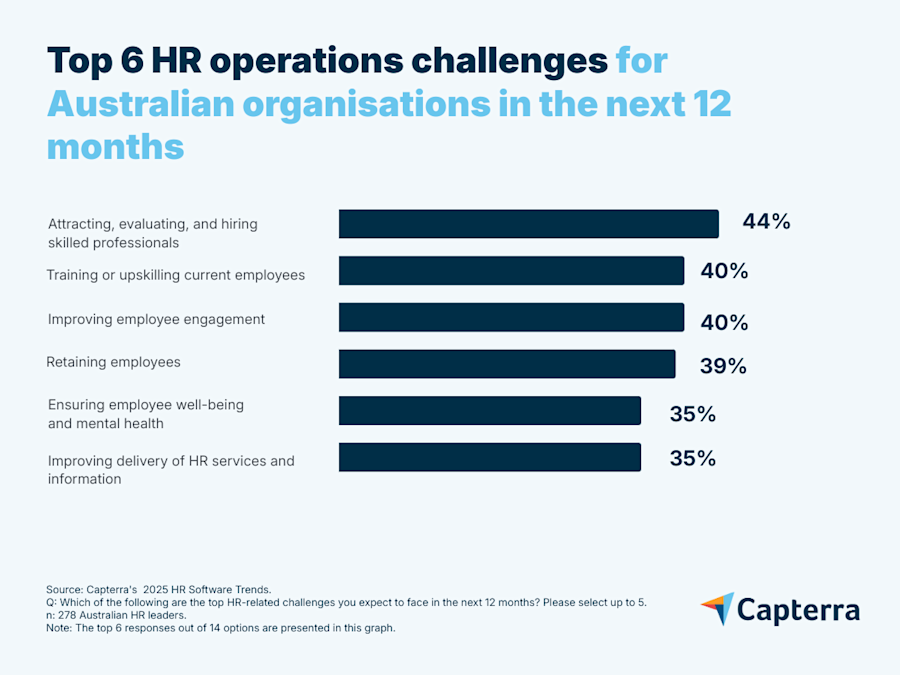
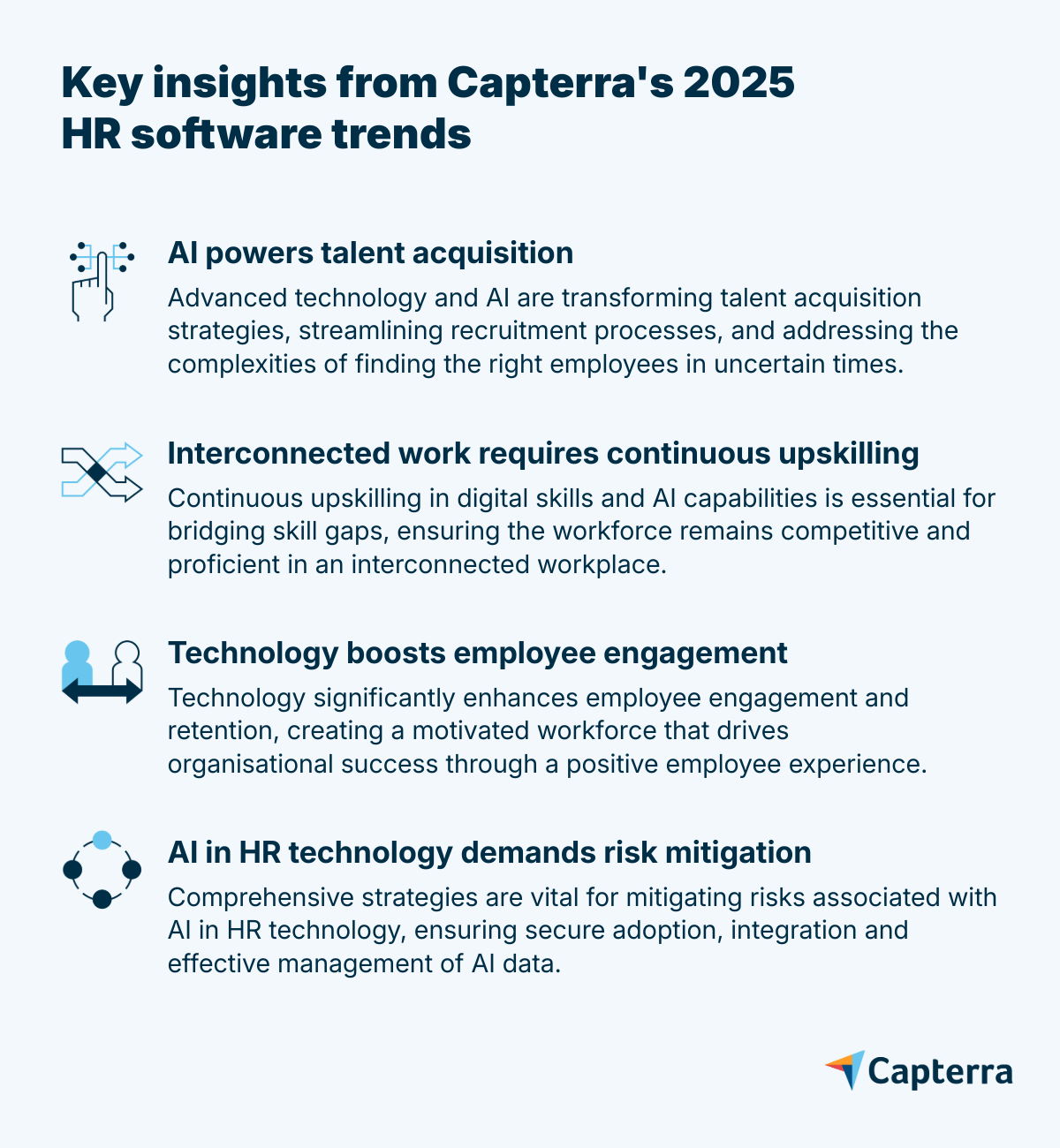
Key Insight 1: AI Powers Talent Acquisition
The challenge
Finding the right employees in complex times requires innovative approaches. With recruiting costs rising and a demand for skilled professionals, organisations must adapt their strategies using technology enhanced with AI, which aids in talent analytics, volume of applications, candidate experience, and better recruitment outcomes.
Dr Marcus Bowles [1], a global expert in workforce development, explains that today's hiring difficulties stem not just from high applicant volumes but from a deeper issue: adaptive capacity. It's no longer only about identifying skilled professionals; it's about engaging and retaining them through the evolving process. He emphasises that while AI helps personalise the experience and improve outcomes, success ultimately depends on how people use the tool.
What Australian HR leaders tell us
- 44% identify hiring skilled professionals as one of the top HR challenges in the next 12 months.
- 69% expect to increase their workforce in the next 12 months.
- 60% foresee recruiting costs increasing compared to last year.
- 31% think that HR analytics is the process that benefits most from AI.
Why it matters
Efficiency is critical when you have less budget and fewer resources, and that's where software can help. Just over two-thirds of Australian HR leaders anticipate that their organisation’s workforce will grow in the next 12 months, but only 30% consider recruiting software critical, despite the process being one of the top challenges for organisations.
However, it is not only about having the technology. HR tools with AI features can help organisations recruit more efficiently and enhance the recruiter-candidate relationship, but soft skills are also needed to engage, connect, and provide a personalised experience to candidates.
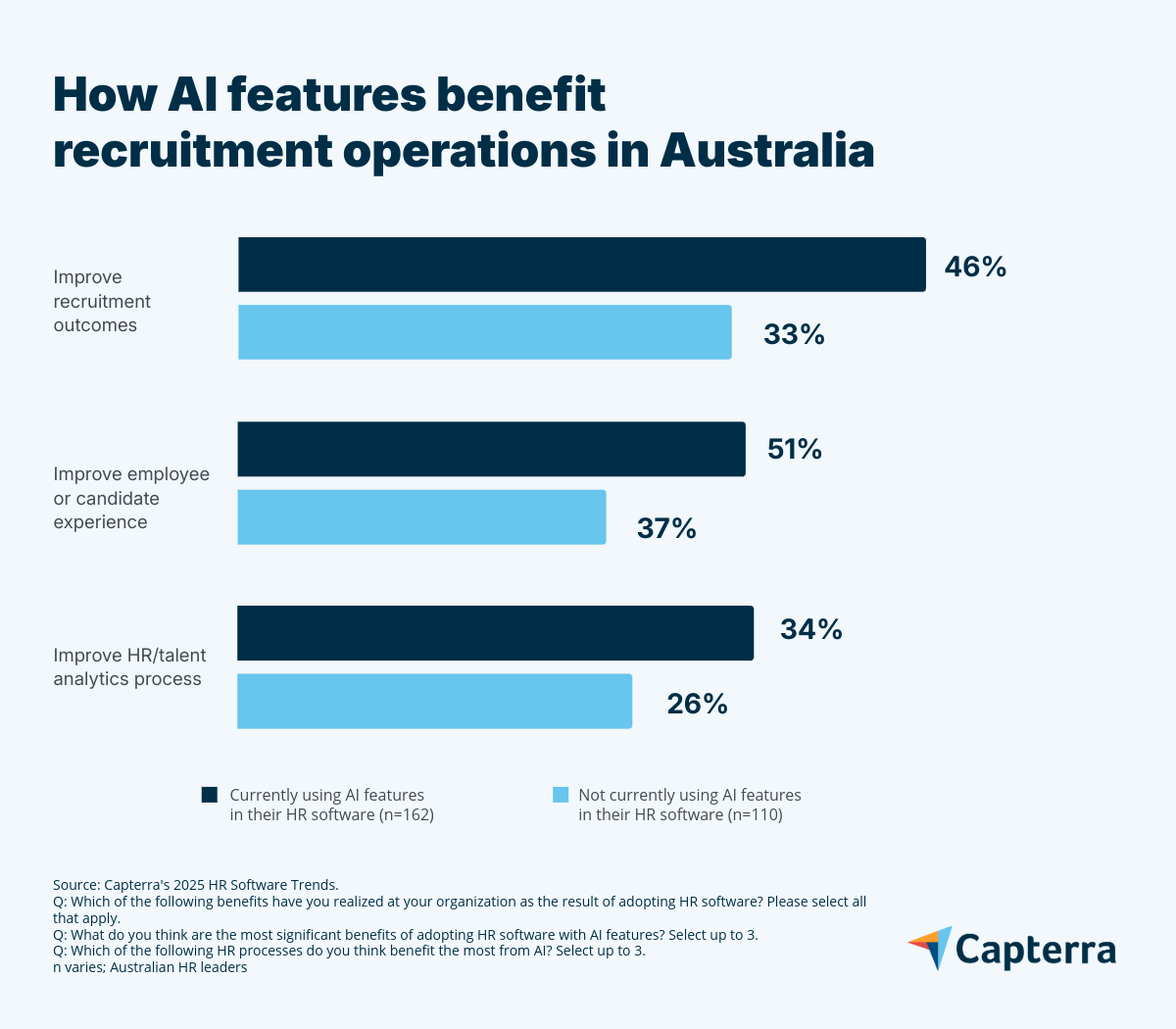
The opportunity
AI-driven recruiting cuts costs and improves hires by automating routine tasks and freeing recruiters' time to build quality candidate relationships. It optimises the identification of effective job posting sources and the selection of compatible candidates.
"AI allows HR to shift from being a reactive function to a proactive one—surfacing insights, predicting workforce needs, and personalising employee experiences at scale."- Dr Marcus Bowles
Recommendations:
- Upgrade recruiting software/ATS with AI features to refine and speed up the early stages of applicant screening.
- Implement AI features in HR/talent analytics to enhance data analysis and candidate evaluation.
- Focus on candidate experience by continuously training your recruiters in soft skills.
-
When implementing AI in recruitment, consider:
- Using AI to support the process, not replace it: candidates still value human interaction and decision-making.
- Being transparent about how AI is used in the hiring process.
- Prioritising candidate experience by offering the option to connect with a human recruiter.
- Learning How To Find The Balance For Successful Implementation of AI in Recruitment.
Software solutions
HR talent analytics: These tools help analyse recruitment data and identify compatible applicants. AI features enhance candidate evaluation by providing predictive insights and automating data analysis. 34% of Australian HR leaders rate this type of software as critical to their HR operations.
Recruiting software and ATS: Both software streamline the talent acquisition process, from sourcing to selection. AI features further improve efficiency by automating resume screening and enhancing candidate matching. 30% of Australian HR leaders rate these types of software as critical to their HR operations.
Key Insight 2: Interconnected Work Requires Continuous Upskilling
The challenge
Upskilling is critical in an increasingly interconnected work environment, and 40% of Australian HR leaders say they expect to face this challenge in the next 12 months. Moreover, organisations will also have to deal with complex software integration and enhance employees' AI skills.
According to Gartner’s report “Quick Pulse: Leader Sentiment on Skills Gaps,” [2] organisations are increasingly concerned about emerging skills gaps and their potential impact on performance and growth goals. 78% of HR leaders are worried about skills gaps at their organisations, and 56% are most concerned with deficiencies in digital skills. So, part of the challenge is also to identify where these gaps are.
"Ongoing training is essential—not just to keep pace with technology, but to embed a culture of critical thinking and responsible use. As AI evolves, we expect the next wave of technical skills—across AI, automation, cybersecurity, and data literacy—to have a shelf life of less than 18 months. This means every HR team must expect to update their technical skills every 2 years." - Dr Marcus Bowles
What Australian HR leaders tell us
- 40% cite training and upskilling current employees as the main operational challenge in the next 12 months.
- 50% indicate training new users on HR software as the main software-related challenge in the next 12 months.
- 71% expect that their training/upskilling costs will increase this year compared to last year.
- 44% highlight insufficient AI skills on staff as a challenge when adopting AI features.
Why it matters
Effective integration and skilled staff are crucial as companies juggle multiple systems, and typically use three HR tools. With AI boosting productivity, out-of-the-box software integration, and HR and AI expertise are essential for competitiveness.
Over half of the surveyed Australian HR leaders indicated that their organisations already use AI features in their HR software, and their expectations of AI contribution to HR software have also increased, indicating a growing need for AI-specific skills. In “Agentic and AI Kick-Starter for CHROs”, [3] a Gartner report, HR leaders estimate that generative AI (GenAI) will impact 37% of the workforce and the way people work in the next two to five years.
However, only 35% of HR leaders in Australia consider training resources critical when researching software, even when the majority foresee an increase in costs in this field and are aware that they have to upskill their employees.
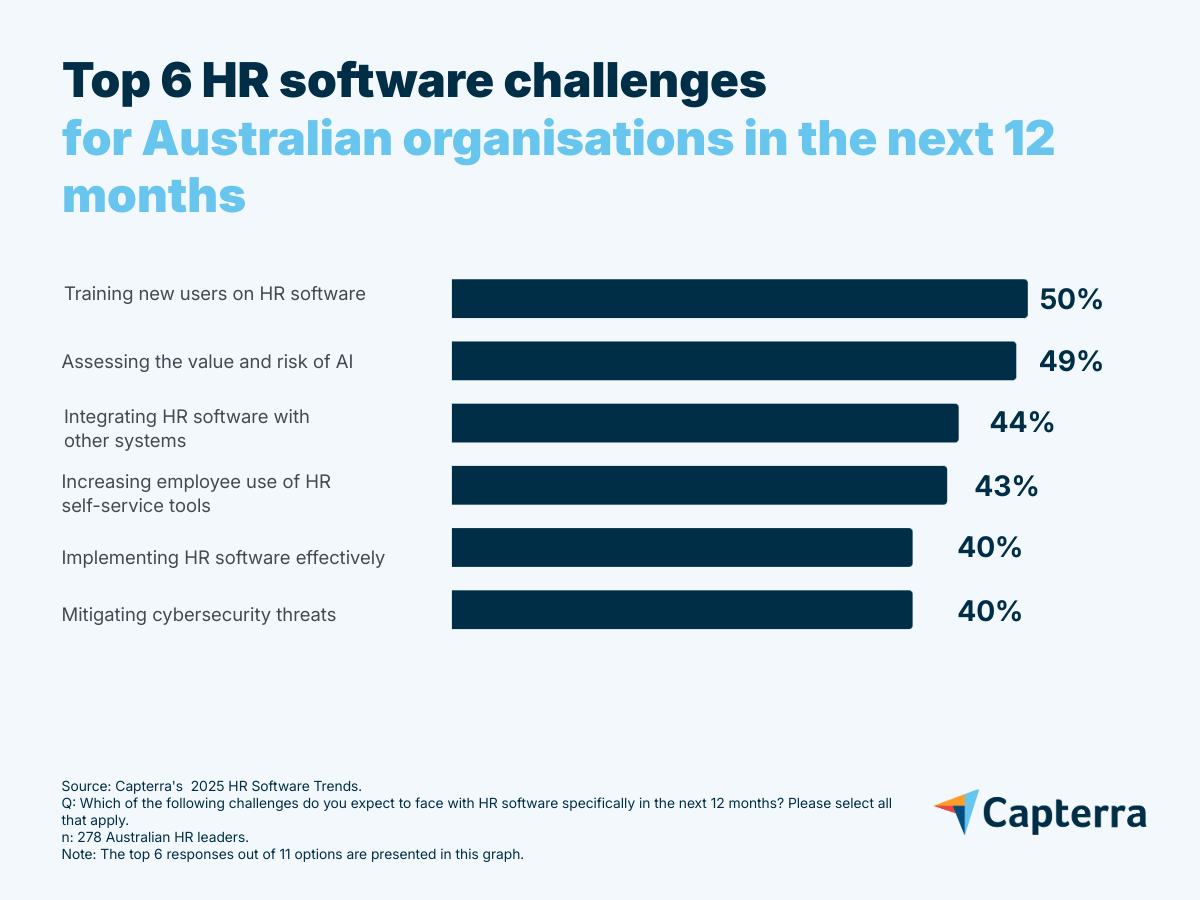
The opportunity
Organisations can address skills gaps and enhance productivity by focusing on upskilling initiatives and making sure they have effective software integrations, leveraging AI to support these efforts. In the current volatile and uncertain context, upskilling employees can be more productive and faster for companies than looking and hiring for specific roles.
“Training fails when it treats users as all about skills transfer and every employee is a passive recipient. The most effective approaches I’ve seen are more authentic, where users learn to use the software to solve real problems in their own workflow."
"The challenge lies in the cognitive load. HR systems often mirror ‘old school’ HR logic—not the user logic of today. Training succeeds when the software is intuitive and the onboarding is continuous, contextual, and embedded in daily use." Dr Marcus Bowles
Recommendations
- Ensure current or upgraded software integrates with the company's HR tech stack.
- Leverage talent management/analytics to ensure smooth software integration and optimise AI capabilities.
- Develop comprehensive training programs: collaborate with leaders and software users to create ongoing upskilling initiatives.
- Invest in workforce training technology, focusing on integrations and AI features, and upgrade the software if needed.
- Regularly monitor the effectiveness of integrations and employee performance/skills.
Software solutions
Human resources information system (HRIS): This type of tool centralises HR data and supports integration with other systems. AI features help automate data sync and enable real-time insights. 47% of HR leaders in Australia rate this type of software as critical to their HR operations.
HR/talent analytics: These tools help identify and address employee skills gaps. AI features can help design personalised upskilling paths. 34% of Australian HR leaders rate this type of software as critical to their HR operations.
Learning management system (LMS): This kind of system supports ongoing training and upskilling in HR software and AI skills. AI features can help create content and templates and personalise the user experience. 34% of HR leaders in Australia rate this type of software as critical to their HR operations.
Key Insight 3: Technology Boosts Employee Engagement
The challenge
Boosting employee engagement and retention is a top HR priority for HR leaders. Identifying the employee experience areas to improve is key, as it drives engagement and, in turn, increases retention.
"HR leaders are realising that employee engagement isn’t solved by a focus on overly simplistic, tactical responses to performance, development, and reward. It requires a human-centred strategy, where technology supports a more personalised, lifelong approach to the employee lifecycle, including deeper focus on the whole employee and their needs—not just measurement against job outcomes." - Dr Marcus Bowles
Using and efficiently integrating tools like compensation software, employee engagement, and benefits administration is crucial for creating a motivated and committed workforce.
What HR leaders in Australia tell us
- 40% identify improving employee engagement, and 39% cite retaining employees as HR challenges for the next 12 months.
- 38% of AI features users in HR software report that they help increase employee satisfaction or engagement, compared to 30% of non-users of AI features.
- 41% of AI features users in HR software report that they help increase employee retention, compared to only 28% of non-users of AI features.
Why it matters
Retaining and engaging skilled employees is key as they are valuable assets who not only perform well but can also train others and drive organisational success. Losing them would mean incurring additional recruitment and training costs and efforts. It is essential to focus on strategies that keep key employees motivated and committed by enhancing their overall experience within the organisation.
"Keep it human-led, AI-enabled. HR leaders must critically assess how AI augments—not replaces—human judgment. Smarter software is a means to an end, not the end itself. Prioritise tools where people remain in control—guiding how data is used and how effort is directed to optimise outcomes that are contextual, strategic, and cultural." - Dr Marcus Bowles
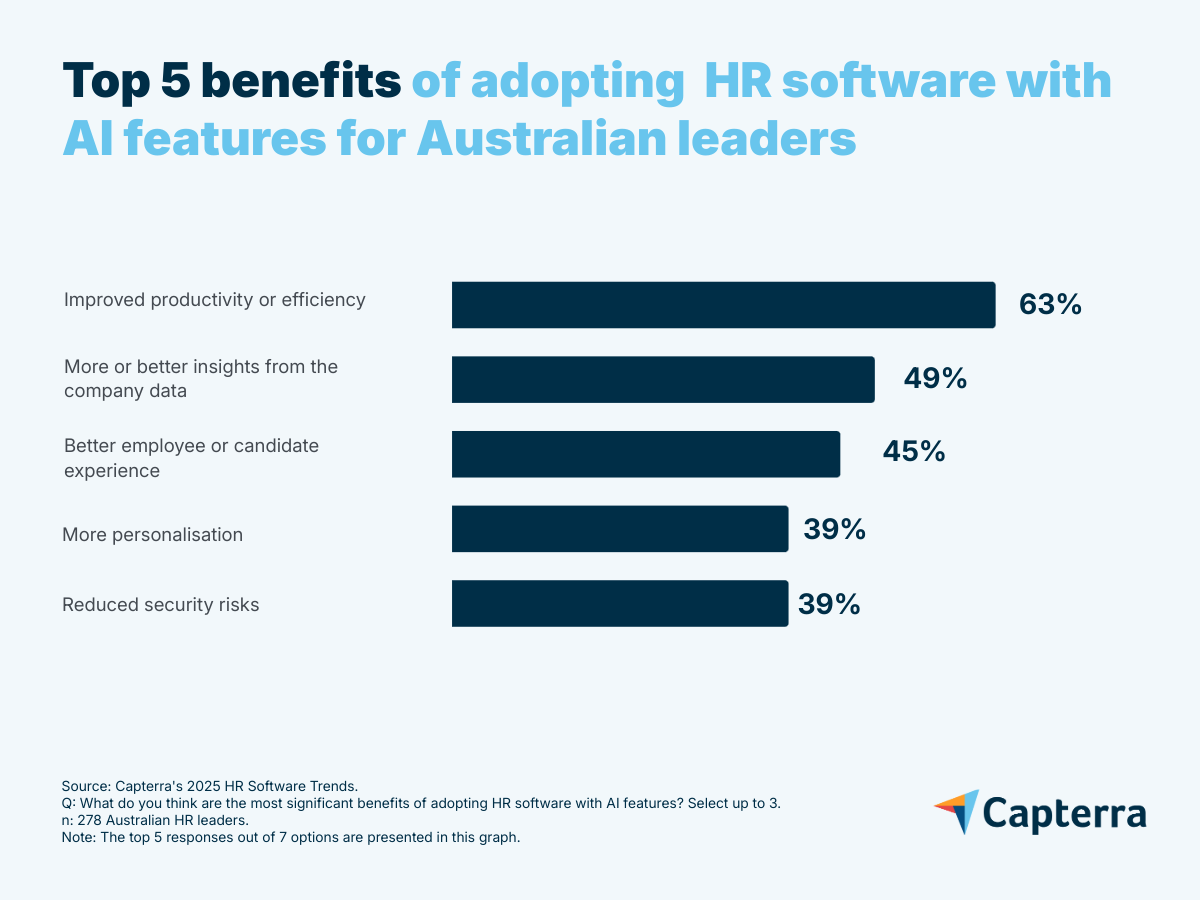
The opportunity
By leveraging technology, organisations can significantly enhance employee engagement and retention. Adopting HR software has led to higher satisfaction and retention rates, while AI features enable the software to provide better insights and, ultimately, enhance employee experience.
Recommendations
-
Conducting surveys regularly to assess engagement levels, pinpoint areas for improvement, and continuously monitor the employee experience (benefits, learning, and growth opportunities) can help develop plans to enhance employee engagement.
-
According to Gartner’s “2025 HR Technology Employee Experience Bullseye” report [4], to improve employee experience, HR leaders should:
- Identify which HR tasks employees prefer to handle in person versus through self-service platforms to better meet their needs and enhance their experience.
- Invest in internal career sites and talent marketplaces to support career growth and retention.
- Focus on user-friendly HR tech to conveniently gather employees' sentiment.
- Promote well-being tool adoption by tailoring offerings to generational preferences, with a focus on mental well-being tools for millennial and Gen Z employees.
-
To support employee retention, HR leaders can leverage the following strategies:
- Use performance management software to analyse employee performance, recognise and reward them accordingly with compensation management tools.
- Use benefits administration software to offer personalised advantages that meet employee needs and maintain work-life balance.
- Leverage talent management software to provide growth opportunities, encourage skill development, and facilitate career advancement, keeping top talent committed. Employees are more likely to stay engaged with the organisation if the management supports their career paths and helps them develop their skills.
Software solutions
Compensation management software: Design competitive pay structures to retain skilled employees. AI can help you benchmark compensation against market data and predict turnover risks based on pay satisfaction. 35% of Australian HR leaders rate this type of software as critical to their HR operations.
Employee engagement software: Foster morale and recognise employee achievements. AI-driven nudges and recognition algorithms can help managers engage employees more consistently. 29% of HR leaders rate this type of software as critical to their HR operations.
Survey software: Collect employees' feedback on what they are missing to feel more engaged. AI features can analyse sentiment and discover patterns in employee concerns.
Key Insight 4: AI in HR Technology Demands Risk Mitigation
The challenge
Australian HR leaders cite the assessment of AI value and risk (49%) and effective software implementation (40%) among their top HR software concerns. Aside from having skilled staff, the main concerns regarding AI include addressing privacy concerns and ensuring there is high-quality data for AI to use.
Organisations must understand the security risks associated with AI, as it will handle information provided from multiple sources (e.g., employees, clients, other software). Skilled employees and the right technology and processes will ensure data integrity.
"Success depends less on the software and more on why and how the people are using it. Without confidence, judgment, systems thinking, and ethical awareness, even the smartest AI tools risk being underused, misused, or misdirected."- Dr Marcus Bowles
What Australian HR leaders tell us
- 40% say effective HR software implementation is a challenge.
- 49% are concerned with assessing AI's value and risks.
- 50% consider security a critical feature when researching HR software to acquire and implement, while 44% report that security concerns triggered HR purchases last year.
- 48% of AI users say reducing security risks is a benefit of adopting HR software with AI features.
Why it matters
AI features must rely on high-quality data and compliance, making data protection and an understanding of AI decision-making crucial for minimising risks. Successful HR software implementation prevents disruptions and secures data. Efficient integrations protect privacy by reducing vulnerabilities. AI literacy is key to understanding how AI works.
Jonah Shepp, Senior Principal, Research, at Gartner, warns that AI, especially generative AI, poses privacy, intellectual property, and trust risks. HR leaders should address these, as employee behaviour is key to preventing data leaks, which could have serious legal and reputational impacts. [5]
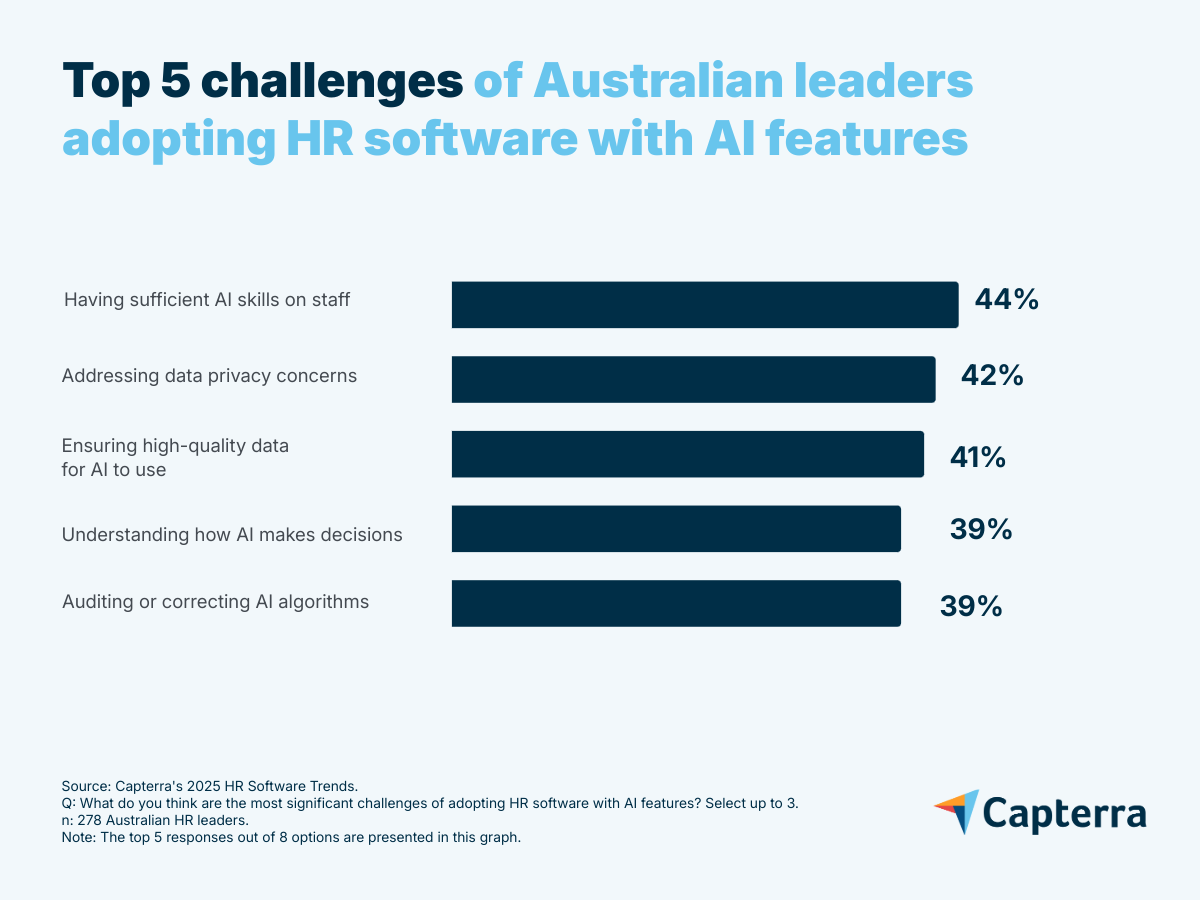
The opportunity
Implementing software properly, maintaining data quality, and understanding how AI works all help mitigate AI risks. HR software with AI features helps reduce security risks, but effective data privacy and management are also crucial for protecting sensitive information and ensuring compliance.
Eser Rizaoglu and Stephanie Clement, both Senior Director Analysts, state in Gartner’s “Agentic and AI Kick-Starter for CHROs” report [3] that cultivating AI literacy—the knowledge and skills to effectively work with AI—is essential for successfully scaling AI within an organisation. Without it, organisations are unlikely to achieve value creation with AI.
Recommendations
- Ensure staff effectively use HR software integrations and understand AI functionalities; implement training programs if necessary.
- Conduct comprehensive data audits to verify data quality, correct usage, and alignment with business expectations.
- Revise data policies to ensure high-quality input and compliance with privacy rules, crucial for both general and AI-enhanced systems.
- Upgrade security features in HR software to safeguard employee data and manage AI-related risks; consider changing the product if necessary.
- Establish clear usage guidelines and regularly assess software functionality and ease of use to improve productivity and reduce user errors.
Software solutions
HR/talent analytics: Leverage these tools to help analyse and improve employee data governance policies aligned with AI data usage. AI features can generate role summaries and risk insights to help organisations quickly evaluate whether user-role assignments are appropriate and compliant. 34% of HR leaders rate this type of software as critical to their HR operations.
Learning management system (LMS): Use LMS to train employees on data collection and AI usage. AI can personalise learning paths based on employee roles and knowledge gaps, ensuring targeted upskilling in data and AI literacy. 34% of HR leaders rate this type of platform as critical to their HR operations.
Data management software: Manage and ensure the quality of data used for the HR software and AI applications. AI features can automate data cleansing and validation processes, reducing human error and ensuring high-quality inputs for AI systems.
Data privacy software: Monitor and enforce adherence to data privacy regulations. AI features help in real-time compliance tracking and automated enforcement of privacy policies.
Adapting HR to Technological Shifts
The future of HR will be defined by how well organisations adapt to rapid technological change and evolving workforce needs. Embracing AI, prioritising upskilling, and safeguarding data are now essential for success. HR leaders who act on these trends will be better equipped to attract, develop, and retain top talent. By keeping people at the centre of every tech decision, organisations can thrive in an increasingly complex world.
Note: The applications mentioned in this article are examples to show a feature in context and are not intended as endorsements or recommendations.
Sources
- Dr Marcus Bowles, LinkedIn
- Quick Pulse: Leader Sentiment on Skills Gaps, by Trisha Rai, February 2025, Gartner
- Agentic and AI Kick-Starter for CHROs, by Eser Rizaoglu and Stephanie Clement, June 2025, Gartner
- HR Technology Employee Experience Bullseye Report, 2025, by Nini Longoria, April 2025, Gartner
- HR Leaders Must Understand the Opportunities and Risks of Adopting AI and GenAI Technologies: Act Now to Prepare for the Future of Work, by Jonah Shepp, December 2024, Gartner
*Methodology
Capterra's 2025 HR Software Trends Survey was conducted in April 2025 among 3,256 respondents in Australia (n=278), Brazil (n=300), Canada (n=289), France (n=300), Germany (n=300), India (n=294), Italy (n=300), Mexico (n=300), Spain (n=300), the U.K. (n=296), and the U.S. (n=300). The goal of the study was to understand the HR software that companies are buying, their benefits and challenges, and the impact of AI on HR. Respondents were screened for employment at companies with more than one employee, working in management-level roles or above. Respondents were also confirmed to be at least partially responsible for HR software purchase decisions within their organisation.